Full scope of practice sounds like one national story. It is really eight different stories, moving at eight very different speeds.
Queensland has had pharmacists treating everyday conditions as standard practice since mid-2025. South Australia only started letting a handful of pharmacies offer similar care this year. That gap is the real story behind the phrase "full scope pharmacist."
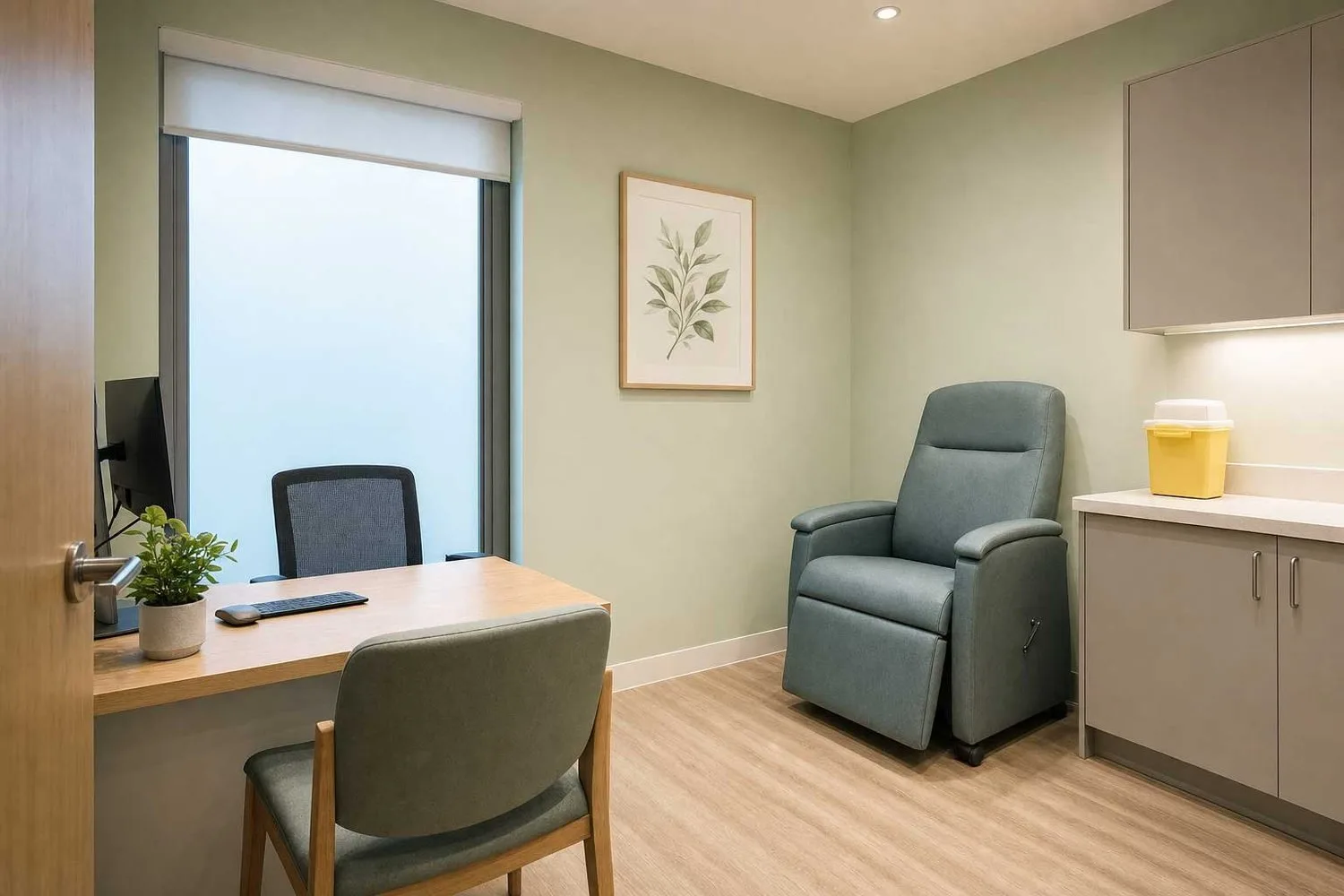
Pharmacies have offered a private consultation space for years. Full scope of practice does not change that. It changes what the room has to be ready for, and how fast that changes again as each state's program grows.
For a pharmacy owner, that is a shift in what the business actually does day to day, not just an addition to a services page. A pharmacy that mostly dispenses runs differently to one that also delivers structured clinical care. The two place different demands on staff time, patient flow and the room itself.
The floor plan is one of the more visible parts of that shift. It is also one of the few parts an owner has direct control over before deciding how far to take it.
Who is allowed to treat what, right now
Queensland got there first. Its pilot began as a 2022 election commitment, scoped to North Queensland only. The scope widened to cover the whole state in 2023, the pilot launched in April 2024, and it became a permanent, business-as-usual service on 1 July 2025. Queensland pharmacists can now treat 17 conditions, the fullest list in the country:
- gastro-oesophageal reflux and reflux disease
- acute nausea and vomiting
- allergic and nonallergic rhinitis
- impetigo
- hormonal contraception
- shingles
- mild to moderate atopic dermatitis
- acute exacerbations of mild plaque psoriasis
- mild to moderate acne
- acute minor wound management
- acute diffuse otitis externa (ear infection)
- acute otitis media (ear infection)
- acute mild musculoskeletal pain and inflammation
- smoking cessation
- oral health screening and fluoride application
- travel health
- management of overweight and obesity
A separate pilot for chronic disease management is still running and continues to 30 June 2027. It covers a cardiovascular disease risk reduction program for type 2 diabetes, hypertension and cholesterol. Separate programs cover asthma and chronic obstructive pulmonary disease. The Queensland Government backed the rollout with a $6 million training subsidy, administered through the Australasian College of Pharmacy.
Queensland did not just launch the program and move on either. Queensland Health engaged Deloitte to run a service evaluation of pilot services. The evaluation is measured against the Australian Institute of Health and Welfare's dimensions of system performance, including access, safety and effectiveness. That is worth knowing if you are weighing up how seriously to take a program still described as a pilot in your own state.
Queensland's own timeline is worth remembering too. A 2022 election commitment took until 2025 to become a permanent service. Today's pilot elsewhere in the country is likely a multi-year project, not a quick trial.
Victoria's current list is shorter than Queensland's, nine conditions plus vaccination. But the state is not planning to stay behind. The Victorian Government made its Community Pharmacist Program permanent on 1 July 2025, backed by an $18 million investment.
The program is already expanding toward 23 conditions through 2026, and that expansion is not just an announcement. Pharmacists gained the ability to initiate the oral contraceptive pill in July 2026, and to treat mild acne and dermatitis the month after.
If the rest of the expansion lands on schedule, Victoria will overtake Queensland's list within the same year this post was written. That says something about how quickly the ranking in this article can go stale. Victoria also funds the consultation itself, so eligible patients are not charged an out-of-pocket consultation fee.
Western Australia has announced a 17-condition list that overlaps heavily with Queensland's, swapping travel health for asthma. The Pharmaceutical Society of Australia's WA president has pointed to Queensland's results as part of the case for the change. But the Enhanced Access Community Pharmacy Pilot does not start until late 2026. As of today, it is a plan, not a service.
NSW sits at the narrower end. Trained pharmacists there can currently manage UTIs, hormonal contraception continuation and a handful of skin conditions. There is also a limited pathway for pharmacists who completed Queensland's own training.
The Australian Capital Territory has followed NSW's lead. An expansion announced in October 2025 added mild musculoskeletal pain, reflux, rhinitis, acne and nausea on top of an existing base of UTIs and oral contraceptive pill resupply. It took effect from early 2026.
Tasmania is narrower again. It covers just UTIs and hormonal contraception, in effect since June 2025, backed by a $5 million commitment. That funding also supports a trial letting pharmacists prescribe for aged care residents alongside their GP.
South Australia has the legal framework in place but is only just getting started. A small number of pharmacies are beginning from early 2026, with more following through 2027, backed by $2.2 million.
The Northern Territory took a different path to get there. A May 2026 amendment to its medicines and poisons regulations created a new category of authorised prescriber. Trained pharmacists in that category can amend an existing prescription and substitute a like-for-like medicine. They can also start treatment for acute conditions, and prescribe or deprescribe certain medicines as part of chronic disease management.
Training must be an accredited pharmacist prescriber course at postgraduate level, with an NT Health subsidy administered through the Australasian College of Pharmacy. Authorised pharmacists then register with the Chief Health Officer for their own prescriber number. The Territory publishes its own minimum standards for consultation rooms and equipment too, in the same vein as every other jurisdiction covered here.
If you are tallying up the dollars, Victoria's is the biggest number. Worth a caveat, though: Victoria's $18 million covers the whole program, while Queensland's $6 million is specifically a training subsidy. They are not quite measuring the same thing, so treat any state-by-state investment ranking as a rough guide, not a scoreboard.
Why the spread? There is no single national scheme behind any of this. Each state and territory runs its own poisons and medicines legislation. Each government has decided independently how far to take it and how fast.
The Pharmacy Guild has been pushing for the rules to be harmonised nationally, so a patient gets the same access wherever they live. For now, that is not the case. A pharmacy in one state can offer a service its counterpart just across the border cannot.
That patchwork matters beyond bragging rights between states. A pharmacy owner near a state border, or one running pharmacies in more than one state, cannot assume a floor plan good enough for one location is good enough for another. Each state's own eligibility rules and room requirements are the ones that count, not a national average.
Vaccination is not the new part
Pharmacists have given vaccinations for years, under their own long-standing facility rules. Most pharmacy owners already understand what that involves. Full scope of practice is really a story about everything else on the list: skin conditions, wound care, contraception, reflux and more.
Every state's version of the program also comes with its own paperwork, software and registration requirements. Each one also expects pharmacists to communicate with a patient's other healthcare providers.
The wound care sink most consultation rooms don't have
Wound care is now a permanent, business-as-usual service in Queensland, and it is on the list Western Australia has committed to. It is a genuinely different kind of service to a quiet chat about a prescription. It involves breaking the skin barrier, however briefly, which raises the bar on hand hygiene in a way dispensing advice never did.
Here is what pharmacies actually have to provide for that, on paper: not much. The rules pharmacies have to meet to participate in these programs mostly just ask for a sink, or a hand washing facility, and most do not say what kind.
Queensland's own room requirements set that sink rule directly. The Quality Care Pharmacy Program adds separate privacy requirements for the consultation area, not the sink itself. It is a voluntary Guild accreditation standard, not a law. No state or territory's published requirements, as far as we have found, go further than saying what kind of sink is needed.
The Australasian Health Facility Guidelines offer a sharper benchmark. They were written for government-funded hospitals and health services, not a retail pharmacy specifically, but the comparison is still useful. The guidelines set out a hand hygiene schedule that assigns a specific type of hand basin to each kind of room.
A Consult Room, the closest match to a pharmacy's private consultation space, is assigned a medium clinical basin. A Treatment or Procedure Room is the closest match to what a wound care service actually is, and it is assigned a larger clinical scrub basin with hands-free taps, operable by elbow, foot or sensor. A basin that is part of an ordinary vanity unit, the type common in retail and beauty fitouts, sits in a third, non-clinical category. The guidelines assign that category to public and staff amenities, not clinical care.
That is the real question a pharmacy adding wound care needs to answer honestly. Is the room still functioning as a Consult Room, or has a procedure-type service quietly turned it into something closer to a Treatment Room? Design Yard 32's consultation room design guide, linked earlier, covers the baseline privacy and hygiene criteria every state expects. Wound care is a reason to check whether the room still matches that baseline, or whether it has taken on a job the fitout was never designed around.
Full scope of practice is reshaping what a pharmacy consultation room needs to do. Are you weighing up applying to your state's program, or already participating and looking to add services like wound care? Design Yard 32's pharmacy consulting room design service can help you work out what your existing space can and cannot absorb. Get in touch to talk through your pharmacy's layout before committing to a renovation brief.
Designing for a program that keeps growing
Every state's list has moved since it started, and Queensland's history is the clearest proof. The commitment to expand pharmacist scope dates back to a 2022 election promise, originally scoped to North Queensland only. The scope widened to cover the whole state before the pilot even launched.
The pilot went live statewide in April 2024, became permanent a year later, and now runs a second pilot alongside it aimed at chronic disease. The program is still adding to itself, years after the commitment that started it.
A room designed narrowly around today's list, whichever state you are in, risks needing another retrofit as soon as the next service is added. A working pharmacy cannot easily close its consultation room for a second round of works without losing trading time and continuity for existing patients. Planning some flexibility into the layout now is a more efficient use of a renovation budget than returning to the same room next year to add what should have been considered from the start.
This is where an interior designer's involvement earns its place. A floor plan built to accommodate a fixed list of today's services is a different exercise to one built to absorb tomorrow's without a second full renovation. That difference is not something a generic fitout brief captures on its own. That is true whether a pharmacy is in a state still waiting for its own program to launch, or one already offering the fullest list in the country.