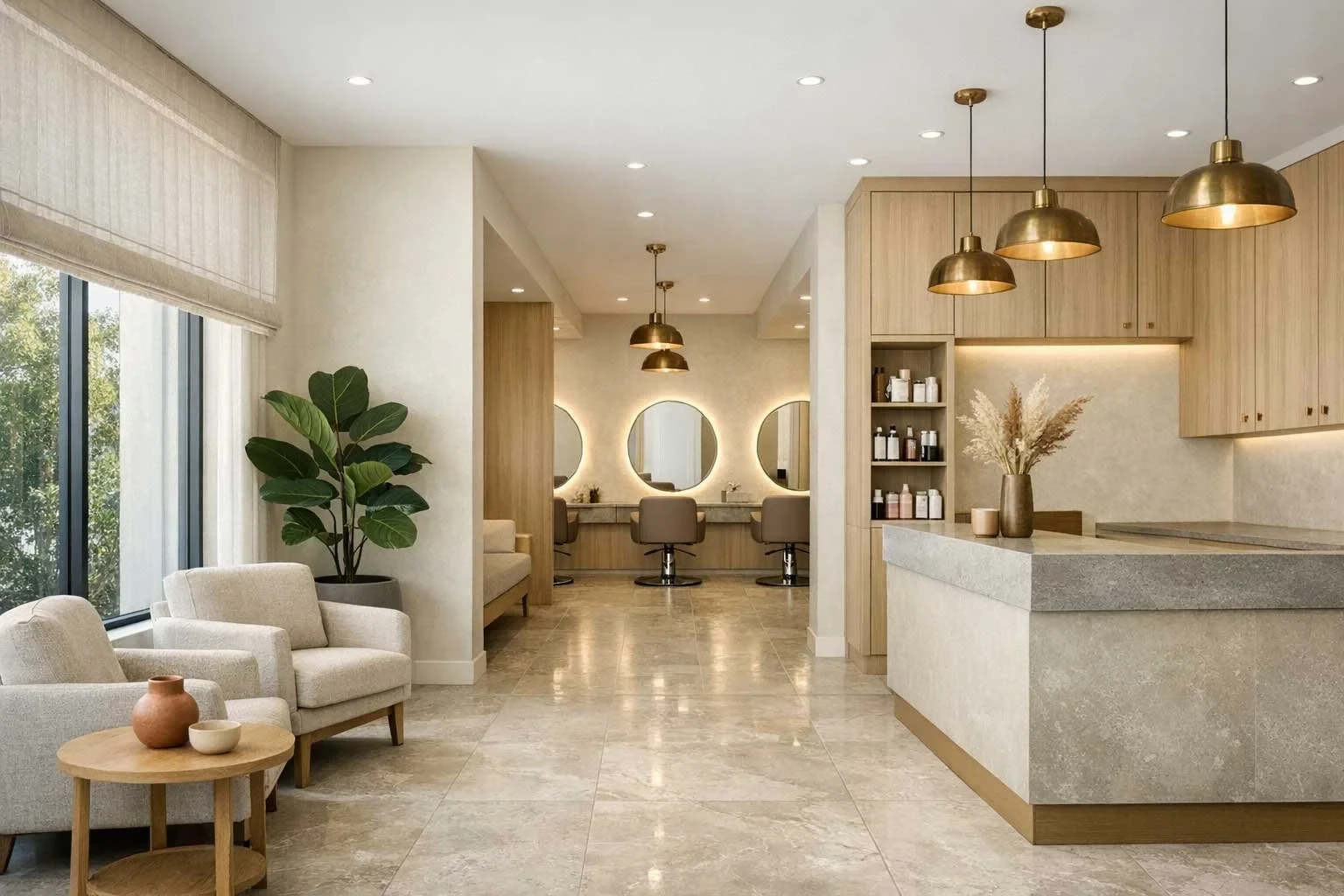
The best salons share something that's hard to name but impossible to miss. You notice it the moment you walk through the door - a sense of ease, of the space working exactly as it should. Clients return not just for the service but for how the space makes them feel. That experience is the result of deliberate design decisions, not happy coincidence.
For salon owners in Melbourne and across Victoria, interior design is often the most underestimated item in a fitout budget. It's easy to focus on equipment costs and council approvals, and treat the look of the space as something to sort out at the end. But the physical environment shapes how clients perceive your pricing, how long they stay, whether they refer others, and whether your staff stay with you. Those are business outcomes, not aesthetic ones. If you are also researching costs, our beauty salon fitout cost guide covers Melbourne price ranges across different salon types.
This guide covers what the best salon interiors actually get right - from lighting and materials to the 2025 NCC accessibility changes that affect any fitout being planned now. For spatial planning and service mix fundamentals, our salon space design guide covers floor plan decisions in depth.
The first impression happens before anyone sits down
A client's assessment of a salon begins on the footpath, not at the reception desk. The shopfront, signage, entrance, and the first few seconds inside the door are all part of the design. They set the price expectation, signal the target client, and establish whether a first-time visitor feels welcome or uncertain.
Reception and waiting areas carry a disproportionate design responsibility. A client who waits 15 minutes in a comfortable, well-designed space has a different experience than one who waits in a chair that faces a cluttered back shelf. The retail display within eyeshot of a waiting client is either reinforcing the perception of expertise or subtracting from it.
Design detail here - materials, lighting levels, the view from the waiting chair - shapes the first impression that determines whether that client books again. It's one of the areas where investment has the most direct return, and one of the areas most commonly treated as secondary.
Lighting - the most impactful decision in any salon
Lighting is where more salons get the design wrong than anywhere else. It's also the element with the most direct commercial consequence - particularly in hair salons and beauty clinics, where the quality of light determines how accurately a colourist can read a client's existing tone, and how confident a client feels when they look in the mirror.
Colour temperature and what it does to your colour work
Colour temperature is measured in Kelvins. Warm light below 3,000K flatters skin but distorts hair colour - orange casts can mask underlying warmth, making grey coverage look more complete than it is under daylight. Cool white light above 5,000K renders colour more accurately but feels clinical. The standard for styling and colour stations is 3,500K to 4,500K - neutral white light that reads reasonably true without creating a hospital atmosphere.
Getting this wrong has practical consequences. A client whose colour looks perfect under warm salon lighting and then steps into daylight outside is a problem waiting to happen - and it's a design problem, not a colourist problem.
Task lighting vs ambient atmosphere
Task lighting and ambient lighting serve different purposes and need separate design decisions. Mirror lighting should eliminate shadows across the face without creating harsh hotspots. Overhead ambient lighting sets the mood of the space and should complement, not fight, the task lighting.
The tension between "looks great on Instagram" and "works for the actual service" is most visible in lighting. Feature pendants and mood lighting create atmosphere, but if the colourist can't see clearly what they're doing, the design has prioritised aesthetics over function. A good salon design resolves both.
Natural light - an asset with conditions
A north-facing shopfront with generous glazing is a genuine design asset - diffused natural light is the most accurate light source available, and clients respond well to spaces that feel connected to the outside. But natural light changes throughout the day and across seasons. A space that works at 10am may be unusable at 3pm due to direct sun glare on mirrors.
Designing around natural light means understanding its direction and intensity at different times of day, managing glare with appropriate glazing or screening, and ensuring the artificial lighting system can compensate when natural light is insufficient. Spaces that rely entirely on natural light without a supplementary lighting plan are a liability.
Materials and surfaces - where aesthetics meet regulation
The materials in a salon have to do more than look good. They need to be durable under commercial use, cleanable to a standard that satisfies health inspections, and - increasingly - considered in terms of their environmental impact.
What Victorian health regulations require from your premises
All beauty and hair salons operating in Victoria must register with their local council under the Public Health and Wellbeing Regulations 2019. The regulations require that surfaces in areas used for client services are constructed from non-porous, sealed materials that can be cleaned and disinfected. This applies to benchtops, flooring, walls behind wet areas, and anywhere instruments are handled or stored.
These aren't arbitrary requirements. Porous surfaces - certain timbers, unglazed tiles, some stone finishes - harbour bacteria and cannot be fully disinfected. The Victorian Department of Health's guidance for hair, beauty and skin penetration industries sets out infection prevention standards in detail, and a council environmental health officer will check these during the pre-registration inspection.
The practical implication is that material selection in a salon is not purely a design decision. Regulatory compliance constrains the finish palette in service areas before aesthetics are even considered.
Durability, cleanability and long-term cost
Hair colour, bleach, acetone, and professional cleaning chemicals take a toll on surfaces that wouldn't be exposed to them in other commercial settings. A benchtop that looks beautiful on day one and is visibly stained within six months reflects poorly on the salon regardless of what service is being delivered.
Specifying materials for a salon requires understanding the actual chemicals they'll be exposed to - not just their appearance on a sample card. Engineered stone benchtops, for example, have widely varying acid and chemical resistance depending on the brand and composition. Porcelain floor tiles need to be slip-rated appropriately for wet salon areas. Painted joinery in colour rooms needs a finish durable enough to withstand regular wiping with harsh chemicals.
Natural and sustainable materials
The move toward natural materials - timber accents, stone, rattan, linen, and tactile textured surfaces - reflects a broader shift in what clients expect from premium salons. It also reflects changing procurement priorities as more salon owners factor environmental impact into fitout decisions.
Sustainable material selection is achievable within the regulatory constraints of a salon. The key is specifying the right products in the right locations - sealed natural timber where it won't be exposed to water and chemical splash, engineered finishes where durability and cleanability take precedence. The design challenge is making the regulated areas feel as considered as the aesthetic ones.
Colour palette and brand identity
Interior design is brand communication. The colours, materials, and spatial character of your salon tell a client something about your pricing, your target demographic, and the experience they should expect - before a single word is spoken.
A colour salon positioning itself at $300 per appointment needs an environment that supports that price point. Mismatched furniture, inconsistent finishes, and an ad-hoc approach to colour send the wrong signal regardless of how skilled the team is. Conversely, an accessible neighbourhood salon that reaches too far for a luxury aesthetic can feel off-putting to its actual client base.
The starting point for any salon design brief is positioning: who is the client, what do they expect to pay, and what atmosphere supports that transaction? Once that's clear, material and colour decisions follow a logic. Without it, design decisions become arbitrary - and the results often show.
Brand identity in a salon isn't just a logo on the shopfront. It lives in the choice between warm and cool tones, between polished and textured surfaces, between open plan and partitioned privacy. These choices accumulate into a coherent environment - or they don't.
The 2025 accessibility changes affecting salon layouts
Any salon being designed or substantially refitted from 29 July 2025 onward must comply with NCC 2022 Amendment 2, which came into effect on that date. The amendment updated the accessibility standard that applies to all Class 6 buildings - which includes retail premises and salons - replacing the previous version with a more stringent set of requirements.
The changes that most directly affect salon layouts include:
- Paths of travel - tighter clearance and slip-resistance specifications for accessible routes through the space
- Doorway reveals - a new maximum reveal depth of 300mm affects how joinery and doorframes are detailed
- Wet area thresholds - updated threshold ramp specifications affect backwash areas, wet treatment rooms, and shower facilities
- Luminance contrast - tightened contrast requirements between floors and walls, particularly at changes in level
- Handrail dimensions and surface specifications - updated sizing and grip requirements
For salon owners planning a fitout now, the implication is practical: designs developed before July 2025 that haven't been reviewed against the updated standard may need revision before a building permit can be issued. Victoria's building and plumbing oversight, now managed by the Building and Plumbing Commission following the July 2025 consolidation of the VBA, applies these requirements to permit applications for commercial premises including salons.
The changes aren't cosmetic. They affect how floor plans are developed, how joinery is detailed, and what's achievable in a constrained tenancy. It's worth raising with your designer at the briefing stage.
Ventilation - where WorkSafe requirements and good design align
Hair colour, bleach, perm solution, nail monomers, and professional cleaning products are all classified as hazardous substances under WorkSafe Victoria's guidance for the hairdressing and beauty industry. Employers have a legal duty to manage the risks these substances create - and adequate ventilation is the primary control measure.
Passive ventilation - relying on openable windows - is rarely adequate in a commercial salon. Mechanical extraction, properly designed and positioned, removes chemical vapours at the source rather than allowing them to accumulate in the breathing zone of staff and clients.
Good ventilation design in a salon doesn't have to be visible or intrusive. Extraction points integrated within joinery, ceiling systems that work with the salon's architectural language, and quiet, well-specified equipment all contribute to a space where ventilation is doing its job without announcing itself. Where ventilation is treated as an afterthought - a duct in the wrong position, a grille that can't be cleaned - it's both less functional and more visually disruptive.
For technical detail on ventilation specifications and chemical safety requirements, our guide to hair salon fitouts in Melbourne covers these in depth.
Designing for your staff, not just your clients
The most overlooked investment in salon design is the one that most directly affects staff retention. A salon where the team is physically comfortable, has adequate storage, can work without straining, and doesn't feel like the back-of-house was an afterthought is a salon where staff stay longer.
Ergonomics at the workstation matter. A styling station at the wrong height creates cumulative strain over a full working day. Backwash basin height and the angle of the neck rest affect both client comfort and stylist posture during a long rinse. These aren't minor details - they're the physical environment your team works in for eight or more hours a day.
Treatment rooms benefit from acoustic separation. A client in a facial room who can hear every conversation from the styling floor has a degraded experience, but so does the therapist trying to maintain a relaxed environment for a skin treatment. Acoustic design isn't expensive when it's planned from the outset - it becomes expensive when it's retrofitted.
Natural light and airflow in staff areas - break rooms, colour prep spaces, stock rooms - affect mood and wellbeing in ways that don't appear in client reviews but do appear in staff turnover. A back-of-house area that's dark, cramped, and poorly ventilated sends a clear message about how the business values its team.
What to have ready before your first design meeting
The briefing process for a salon interior design project is led by the designer. Design Yard 32 prepares and works through a detailed design brief with each client, rather than asking salon owners to prepare a written document in advance. What helps is arriving at that first meeting with clear answers to a handful of practical questions. For help selecting the right designer for your salon, see our guide to choosing a salon interior designer.
Your service list and approximate volume at each station - how many styling chairs, backwash basins, treatment rooms, nail stations - shapes the floor plan from the first sketch. Having this settled before the briefing avoids designing for one business and building another.
Your lease terms, tenancy dimensions, and any information from the landlord about what work requires consent affects the scope of what's possible. For salon owners in Melbourne and across the Mornington Peninsula, knowing whether your council requires a pre-lease environmental health assessment before signing is worth establishing early.
Brand direction - colours, references, what you love and hate about salons you've visited - doesn't need to be formal. A folder of saved images or a conversation about the feeling you want to create gives a designer far more to work with than a vague brief about wanting something "modern and fresh."
Finally, a realistic budget range. Salon fitout costs in Victoria vary significantly depending on scope, the condition of the tenancy, and the level of finish. A designer who knows the budget can make better decisions earlier, rather than producing a scheme that has to be value-engineered at the end.