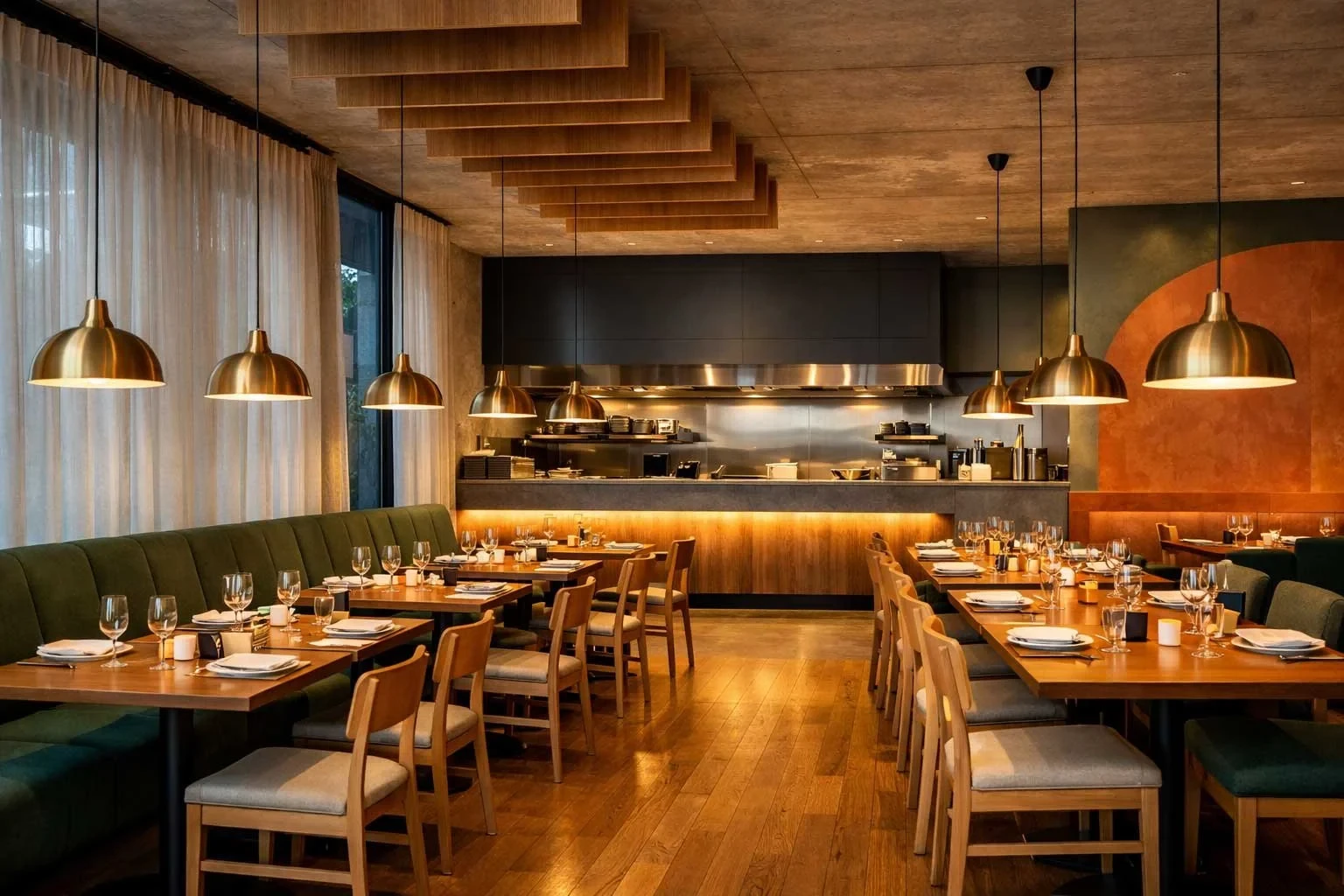
Restaurant interior design is the spatial planning, material selection, lighting strategy, and atmosphere creation that determines how a dining venue performs - how consistently it fills, how smoothly it transitions between services, and whether first-time visitors return.
The best restaurant interiors are not accidents. The ones that fill consistently, that transition smoothly from lunch to dinner, that make guests want to stay for another glass - they were designed that way. The decisions behind those outcomes were made long before the first coat of paint, in the brief stage, in the floor plan, in the choice of materials and lighting circuits.
Restaurant interior design is different from residential work, different from a cafe fitout, and different from a bar. The operating model - table service, longer dwell times, a commercial kitchen producing full menus - changes the brief in ways that matter from the first drawing to the last fixture. This guide covers the decisions that have the most impact, the regulatory changes affecting Victorian fitouts in 2025 and 2026, and what to have ready before your first meeting with a designer.
A Restaurant Is Not a Cafe
Most hospitality fitouts begin with an aesthetic reference. The operator brings images - restaurants they have eaten in, overseas inspiration, a specific material palette. That is a useful starting point. But it is the operating model that determines everything structural about the design.
A cafe is typically built around counter service and relatively fast turnover. A restaurant is built around table service, longer dwell times, and a more complex kitchen. Those differences cascade through the design brief in ways that are not obvious until you are planning the floor.
Table service means your staff are moving through the dining room constantly. Aisle widths need to accommodate two people passing, not one. Seating density that works in a counter-service cafe will feel cramped in a table-service restaurant. The bar, if there is one, serves a different function - it is a waiting area and a destination in its own right, not just a service point.
Kitchen complexity in a restaurant is substantially higher than in a cafe. You are planning for a hot line, cold prep, a pass, dishwash, and separate storage for dry goods, refrigeration, and waste. That back-of-house footprint directly reduces the front-of-house area available for covers - and the balance between the two is one of the most consequential decisions in the brief.
Longer dwell times raise the bar on acoustics, comfort, and lighting in ways a cafe does not face to the same degree. A guest who spends 20 minutes at a counter and a guest who spends two hours at a table have very different experiences of the same noise level or seat cushion. The threshold for acceptable is higher in a restaurant, and that needs to be reflected in the design from the start.
If you are planning a cafe fitout specifically, our Melbourne cafe fitout guide covers the food safety, permit, and kitchen compliance process in detail. The considerations below apply to restaurant fitouts, where the brief and the stakes are different.
Cover Count Is a Design Decision
Table geometry and spacing
The number of covers your restaurant can hold is one of the most important numbers in your business model. It sets the ceiling on what a fully booked service can earn. And it is largely fixed at the fitout stage.
Table geometry - the size of each table, its shape, and how tables are positioned relative to each other and to walls and circulation paths - determines cover count. The same 200 square metre dining room can hold anywhere between 50 and 100 covers depending on how it is laid out. That difference translates directly into weekly revenue.
Australia's national accessibility requirements for buildings set minimum aisle widths that cannot be reduced below a certain point regardless of how the operator wants to pack the room. But meeting the regulatory minimum and optimising for commercial performance are two different exercises. A designer working from your actual cover target will plan layouts that maximise productive floor area while keeping circulation paths workable for staff and guests.
The cover target should be established at the brief stage, not discovered when the furniture arrives.
Seating mix
Not all seating performs equally in terms of commercial output or guest experience.
Booths offer comfort and acoustic separation that loose seating cannot match. The tradeoff is rigidity - a four-person booth holds four covers on a night with a table of two just as much as a night with a table of four. You cannot combine booths for a large group.
Banquettes run along walls and pair with loose chairs on the opposite side. They provide much of the comfort and acoustic benefit of booths with more flexibility for group sizing. A long banquette can seat couples, fours, or a large table depending on how chairs are arranged opposite it.
Loose seating is the most flexible configuration. Tables can be combined or separated to match the booking sheet. The tradeoff is acoustic - loose seating on a hard floor with no adjacent soft surfaces absorbs very little sound, and that compounds as the room fills.
Bar stools at a counter or bar area offer the fastest turnover and the lowest dwell time of any seat type in the venue. For a restaurant with a genuine bar offer, bar stools are a separate revenue stream, not waiting seats.
The right mix depends on your market and service model. A neighbourhood restaurant doing long weekend bookings needs a different configuration than a city venue running a fast lunch trade.
Lighting Across Two Service Periods
The lunch-to-dinner shift
Many restaurants need to run the same room as two quite different environments in a single day. Lunch service at a lower spend per head typically needs more light - guests are reading menus, the room feels active, natural light is part of the offer. Dinner service at a higher price point works better with lower ambient light, warmer colour temperatures, and atmosphere over function.
Making that shift possible requires independently switched and dimmed lighting circuits. This is a wiring and switching decision made at the fitout stage. Adding separately controlled circuits after handover means cutting into walls, replacing fittings, and replanning switching panels - work that is both expensive and disruptive in an operating venue.
The treatment of natural light matters as much as artificial lighting. Windows that work beautifully for a Sunday lunch can undermine Friday dinner service if they face west with no treatment. Blinds, film, or screening designed as part of the fitout rather than added later integrates better and performs better.
Feature lighting vs working light
Feature lighting - pendants, wall sconces, architectural LED details - creates the atmosphere guests experience and photograph. Working light - the illumination that lets staff read dockets, see into the pass, and move safely through a service - needs to function independently without spilling across into the dining atmosphere.
Colour temperature is relevant here. Warmer sources (around 2700-3000K) create a flattering dining environment. Cooler temperatures support visual accuracy for kitchen and service work. Getting both into the same building requires that the lighting zones be planned separately from the start.
Emergency lighting is a compliance requirement under the National Construction Code. Its positioning and integration is a design decision. There is a significant difference between emergency lighting that reads as intentional and emergency lighting that looks retrofitted.
Acoustics - the Problem You Fix in the Fitout or Pay For Later
Why restaurants go wrong acoustically
Noise is among the most consistently cited complaints in Australian restaurant reviews. It is also one of the most preventable design failures in a hospitality fitout - and one of the most expensive to address after handover.
The acoustic problem in most restaurants is reverberation. Sound bounces between hard, parallel surfaces rather than being absorbed. The interior aesthetic that dominates Melbourne's restaurant scene - exposed concrete ceilings, polished timber floors, glass facades, open plan rooms - is a poor combination acoustically. Each of those surfaces reflects sound rather than absorbing it. In a full room at 80 covers, the effect compounds: the louder the room becomes, the louder guests have to speak to be heard, which raises the room level further still.
The result is a space that is technically compliant, visually appealing, and practically unusable for two-hour dinner bookings. Guests notice. They choose quieter venues the next time they make a reservation.
What the fitout stage can do
Acoustic treatment is most cost-effective when it is designed into the fitout from the start. The same outcomes achieved after handover typically cost more and look worse.
Upholstered seating - booth backs, banquette cushions, chair pads - absorbs sound at or near the source. Suspended ceiling elements (panels, baffles, hanging decorative features specified in acoustic-rated materials) reduce reverberation without requiring changes to the floor or structural walls. Fabric art, curtains, and upholstered wall panels can be designed as aesthetic elements that also perform acoustically.
Post-handover approaches are less effective. Carpet on a commercial floor creates cleaning and fire compliance issues. Foam panels do not meet commercial fire-resistance requirements. Remediation in an operating restaurant is expensive, disruptive, and rarely achieves what good design at the fitout stage would have delivered.
For how acoustics play out specifically in a bar context - including the compliance requirements around patron noise and adjoining uses - bar design addresses those considerations separately.
The Open Kitchen - What the Trend Actually Requires
Open kitchens have moved from a fine dining feature to a standard expectation in new restaurant fitouts. Guests trust what they can see, and the visual connection between kitchen and dining room creates energy that a closed kitchen cannot offer.
The design implications are more involved than most operators expect before they go through a fitout.
Mechanical ventilation in a commercial kitchen is required regardless of whether the kitchen is open or closed. What changes with an open kitchen is that the canopy hoods, make-up air supply, and exhaust pathways are visible to the dining room for the entire service. A well-designed open kitchen treats the ventilation canopy as a design feature. A poorly considered one treats it as a compliance afterthought, and that reads immediately.
Kitchen noise travels directly into the dining room without a physical wall to contain it. Extraction fans, oven doors, the rhythm of a busy service - all of it enters the dining room. Acoustic absorption within the kitchen itself, pass design that creates a functional buffer, and equipment selection all contribute to managing how much of that reaches the guest.
The pass is a design element as much as a functional handoff point. Its height, material, and lighting set the tone for how food moves from kitchen to table. In an open kitchen, the pass is on display for the entire service, and it needs to be treated accordingly.
Outdoor Dining in 2025 - What's Changed in Victoria
Public land vs private land
The Victorian Government made significant changes to outdoor dining approvals in 2025 that affect how operators plan alfresco areas in new and renovated venues.
As of 27 June 2025, outdoor dining on public land - footpaths and roadways adjacent to a hospitality venue - is permanently exempt from planning permits under Victorian planning schemes. The exemption covers furniture, marquees, and all-weather coverings, provided the area is associated with the adjoining venue and authorised by local law or the relevant public land manager. A kerbside trading permit from the relevant council is still required in municipalities where one applies.
For operators in inner-city, strip shopping, or main street locations, this is a meaningful change. What previously required a planning permit application - with the associated time and cost - now requires local council authorisation and a kerbside trading permit.
Private land is treated differently. An outdoor area in a rear courtyard, on a rooftop, or in an enclosed external passage sits on private land. If the works involve a change of use, structural construction, or a new roof structure, a building permit and potentially a planning permit are still required. Heritage overlays apply regardless of whether the land is public or private - a restaurant in a heritage precinct requires referral to Heritage Victoria for works inside or outside the building.
What still needs a permit
The practical rule is straightforward. Footpath and public road dining adjacent to your venue - planning permit step is gone. Outdoor works on your own land that involve construction - permit process still applies.
From 1 July 2025, amending a liquor licence or modifying a red line plan also no longer requires a planning permit. That application goes directly to the state liquor regulator, removing a step that previously added time and cost to any licenced venue change.
The Victorian Building Authority can assist with identifying the permit pathway for specific building works if the scope is unclear.
What NCC 2025 Means for New Restaurant Fitouts
The National Construction Code is updated on a rolling basis, and the 2025 edition introduces changes that affect how new restaurant fitouts are designed and permitted. The 2025 code was published for preview in February 2026, with adoption anticipated from May 2026. Individual states and territories are yet to confirm their own adoption timelines.
Two changes are most relevant to restaurant operators planning a fitout now.
The first is mandatory on-site solar PV for new commercial buildings. The obligation to install a solar system covering usable roof space typically sits with the building owner rather than the tenant. For operators fitting out a leased tenancy, this is primarily a building permit timing question - whether the building has already complied or whether the owner is in the process of doing so, and whether that affects the permit path for the fitout itself.
The second is a change to bathroom facility ratios. NCC 2025 requires a higher proportion of female toilets in commercial premises. For a restaurant fitout, this is a floor plan question that needs to be answered early. Bathroom space allocation affects how much floor area goes to amenities versus covers, and that calculation changes under the 2025 standard. Adjustments identified at the brief stage cost nothing. The same adjustments discovered at permit submission require rework.
Any fitout where building permit approval is expected after the state adoption date should account for NCC 2025 requirements from the first design meeting.
What to Have Ready Before Your First Design Meeting
Restaurant interior design works best when the brief is grounded in the actual operating model from the start. A designer should lead you through the brief process - and having the following information ready means that conversation moves faster and the design that comes out of it is specific to your business.
Bring the lease drawings, or the building's as-built drawings if available. These establish the structural constraints the design has to work within - columns, services, floor-to-ceiling heights, and any existing penetrations.
Know your operating model: table service or hybrid, the service periods you are planning to run, and whether you intend to operate a bar as part of the venue or include a simple service bar only.
Have a cover target in mind. You may not have a precise number, but knowing whether you are aiming for 60 or 120 covers affects the fundamental layout decisions, and the designer will test that target against the available floor area as one of the first steps.
If you hold or plan to apply for a liquor licence, bring the licence type and any conditions that currently affect seating layout, outdoor areas, or service hours. Licence conditions shape certain design decisions directly, and it is easier to design around them from the start than to retrofit compliance after documentation is complete.
Your target opening date, and any firm constraints on it, allows the designer to sequence the brief, design, documentation, and permit phases against a realistic timeline. Our hospitality design work covers restaurants, cafes, and bars - and the brief process is where all of it starts.