Medical fitout costs in Australia typically range from $2,500 to $4,500 per square metre for general practice and primary care fitouts, with specialist clinical environments - sterilisation rooms, X-ray suites, procedure rooms, and complex mechanical and electrical installations - at the higher end or above. These figures cover the builder's construction scope and exclude medical equipment, design fees, regulatory approvals, and fit-out levies. The only reliable cost figure for a specific project is a builder's quote against completed plans and specifications.
Every GP owner and practice manager planning a fitout reaches the same question early: what is this going to cost? The honest answer, before plans are drawn and builders are tendered, is that no figure published anywhere - including in this post - is a quote. What you actually pay depends on where in Australia you are, what condition the tenancy is in when you take it, what type of practice you are running, and what the builder prices when your designer puts completed documents out to tender.
Published benchmarks are useful for early feasibility conversations. They are not a substitute for the proper cost process, and treating them as such is one of the most common reasons medical fitout budgets blow out. This guide walks through what actually drives the cost of a medical fitout in Australia, what the current market is doing in 2026, what tends to catch practice owners off guard, and how to approach your budget sensibly before you have anything to price.
If you are specifically looking at costs, approvals, and timelines for a Melbourne or Victoria-based project, our guide to medical centre fitout costs in Melbourne covers the Victorian market in more detail. This guide takes a national view.
Why No Two Medical Fitouts Cost the Same
Shell condition - the biggest single variable
Before any other variable, the condition of the tenancy you are starting from sets the floor for what your fitout will cost. The industry distinguishes between warm shell and cold shell tenancies, and the difference between them can account for a very significant portion of your total budget.
A warm shell tenancy has core services infrastructure already in place - HVAC, electrical mains, plumbing rough-ins, and typically a finished ceiling and lighting grid. A fitout in a warm shell focuses on partitioning, clinical joinery, finishes, and connecting your fit-out to existing services. Most suburban medical suites in established medical precincts are warm shell, which makes them popular with practice owners fitting out for the first time.
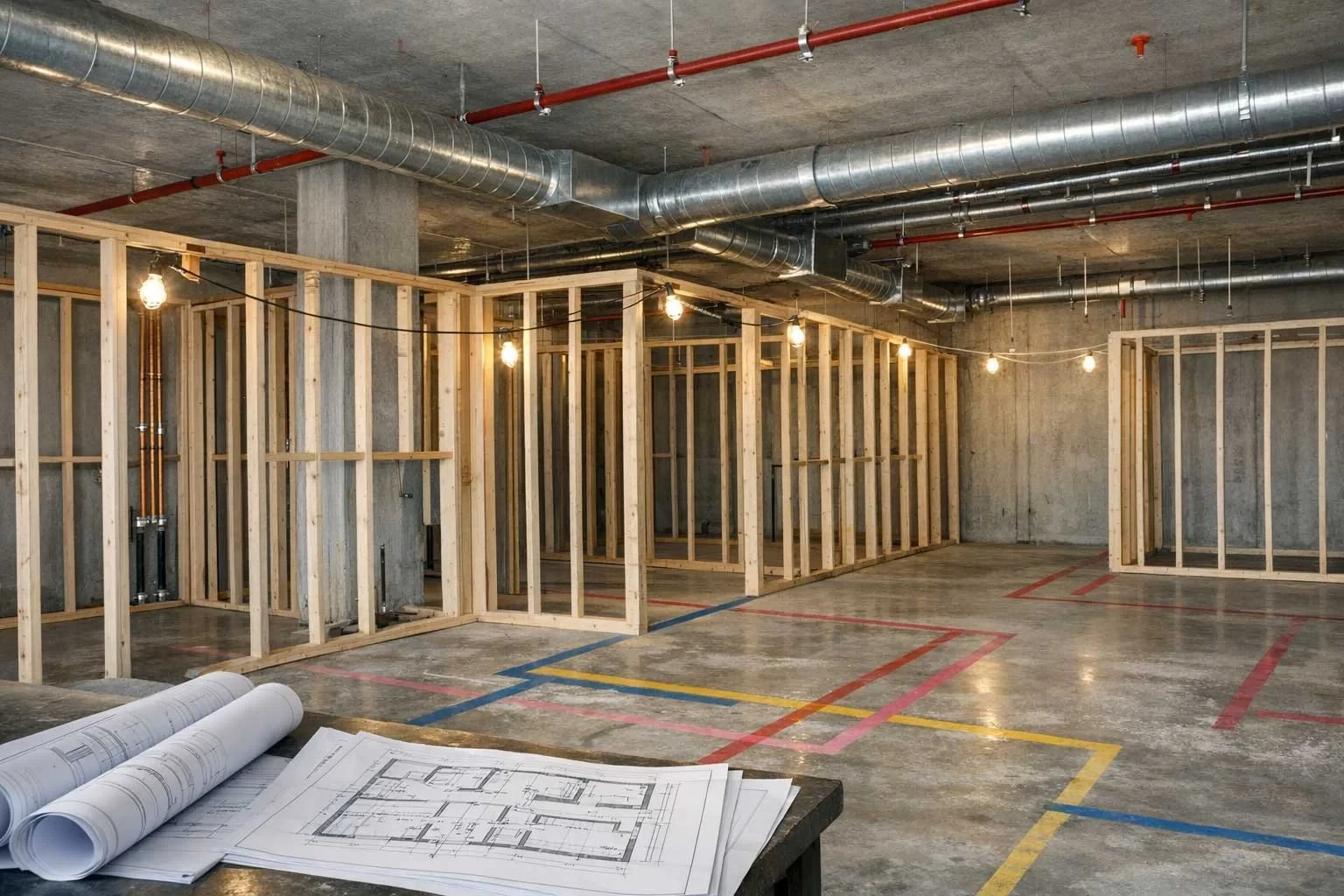
A cold shell is structural only. There are no services installed, no ceiling, no lighting - just the concrete slab, structural columns, and the building envelope. Fitting out from cold shell means building the entire services infrastructure from scratch: HVAC systems, all electrical runs, hydraulics, data cabling, and the ceiling structure to house them. Cold shell fitouts cost materially more per square metre and carry longer construction timelines. Some newer commercial buildings are delivered as cold shell even in established locations, which can surprise a lessee who has not confirmed the condition before signing.
Confirming the shell condition with the landlord before committing to a lease is one of the most important checks a designer with medical fitout experience can help you make - and one of the most useful to do before you are contractually committed, not after.
Practice type and compliance tier
Not all medical fitouts are built to the same compliance standard, and the gap between a straightforward GP consulting suite and a specialist facility with procedure rooms or imaging infrastructure has a direct effect on cost.
The National Construction Code draws a clear line between two building classes that apply to medical facilities. Class 5 - standard commercial office - covers facilities where patients remain ambulatory throughout: GP clinics, specialist consulting rooms, allied health practices, and diagnostic facilities such as radiology and pathology. For a detailed look at what goes into designing a GP clinic - from RACGP accreditation requirements to room types and planning permits - see our GP clinic design and fitout guide. Class 9a - health-care buildings - applies where the predominant treatment renders patients non-ambulatory and requires supervised on-site recovery: day surgery centres, endoscopy and colonoscopy suites, procedure units using IV sedation or general anaesthesia, and similar facilities. The classification turns on self-evacuation: Class 9a exists because those patients cannot leave the building unassisted in an emergency.
Class 9a imposes meaningfully stricter requirements than Class 5: fire-rated construction, additional egress provisions, accessible bathroom facilities, and specific ventilation and clinical surface requirements. A fitout that crosses into Class 9a - or that involves converting a non-medical tenancy to medical use - carries a higher compliance cost than a standard commercial fitout in the same building. Specialist equipment requirements add further cost that does not appear in any per-square-metre benchmark: medical gas systems, radiation shielding for imaging, sterilisation rooms meeting the RACGP's GP practice standards and infection control requirements. Dental fitouts sit in their own cost category, shaped by suction systems, sterilisation, and chair configuration requirements - our dental fitout guide covers those specifics.
State and location - why costs vary across Australia
Medical fitout costs are not uniform across Australia, and the gap between markets has widened in recent years as regional construction demand has diverged significantly. Rather than citing exact state-by-state figures - which shift with market conditions and bear no direct relationship to your specific project - it is more useful to understand the directional picture.
Brisbane and the Gold Coast have been tracking meaningfully higher than Melbourne and Sydney in recent quarters, driven by a sustained infrastructure pipeline and downstream demand from Olympic-related construction activity. Perth remains elevated due to resources sector activity competing for the same trade labour pool. Melbourne and Sydney have more established contractor markets and somewhat broader builder competition, which creates more competitive tension at tender. Adelaide and regional centres vary, but regional locations of any state carry a consistent premium relative to inner-metro equivalents - tradie travel time, materials freight, and reduced builder competition all contribute.
A practice in regional Queensland or rural WA is likely to face higher per-square-metre costs than an equivalent inner-suburb Melbourne fitout, even before accounting for the underlying state market differences. Understanding where your project sits in this landscape is part of what a medical fitout designer with national experience can help you assess before you begin.
What's Driving Costs Higher in 2026
The labour market that is not getting easier
The persistent driver of construction cost escalation in Australia is not materials - it is labour. Specialist trades are among the hardest roles to fill nationally, and medical fitouts require exactly the trades in shortest supply: electricians capable of installing medical-grade isolated power panels and body-protection circuits, plumbers for hydraulic systems and medical gas lines, and HVAC specialists for clinical-grade ventilation systems.
Enterprise agreements negotiated across Sydney, Melbourne, Brisbane, and Perth have locked in approximately 5% annual wage growth for construction workers for the next three to four years, according to Turner & Townsend's Global Construction Market Intelligence report. This is not a temporary shock - it is structural, embedded in multi-year agreements that are now running across the major construction markets. The Fair Work Commission's annual wage review adds further upward pressure on the lower end of the trades workforce. Master Builders Australia has consistently identified skilled trade shortages as the primary risk to project costs and timelines in current conditions. Near-term labour cost relief is not anticipated in any of the major capital city markets.
Materials - copper, HVAC, and the import cost squeeze
While labour dominates the cost escalation story, materials have added significant pressure of their own in 2025-2026. The most consequential, and the one least visible to practice owners, is copper. Copper prices rose sharply year-on-year, crossing US$13,000 per tonne in early 2026 according to Altus Group's Australian Construction Price Outlook. Medical fitouts are copper-intensive in ways that standard commercial fitouts are not: hydraulic pipework, medical gas lines, electrical cabling, and HVAC systems all rely on copper, and medical gas systems require medical-grade copper specification that commands a further premium above standard construction copper. A single fitout's worth of copper-dependent services carries meaningfully higher material costs than it would have 18 months ago.
HVAC systems for clinical-grade ventilation are frequently imported, and two factors are compounding procurement costs simultaneously. New US tariff changes on imported mechanical equipment and related components are feeding through into project budgets. The Australian dollar has weakened against major trading currencies, which multiplies the local cost impact of any imported equipment. These pressures are not isolated - they are applying concurrently to several of the most significant line items in a medical fitout budget.
Fuel, freight, and what it means for practices outside major CBDs
Fuel costs tracked by the ACCC's fuel monitoring program have risen to elevated levels, reflecting the sustained impact of global supply disruptions including geopolitical pressure on Middle East supply routes. Diesel pricing feeds through into construction projects via plant hire rates, materials freight, and the daily transport costs of trades travelling to site.
For practices in inner-city locations with multiple builders operating nearby, fuel is a background cost. For practices in outer suburban or regional locations, it becomes a visible component - tradie travel, materials delivery, and design site visits all carry a freight element that compounds with distance from supply chains. This is worth factoring into a regional or outer-suburban project budget, and worth understanding when comparing quotes from metro-based and locally-based contractors, as each will price their supply chain differently.
The Costs That Don't Show Up in Sqm Rates
Building age and what older tenancies often hide
A significant proportion of Australia's suburban medical precincts occupy buildings constructed in the 1970s, 1980s, and 1990s. These buildings often present cost risks that are not visible in a walk-through and do not appear in any published benchmark.
Asbestos is the most common. Materials containing asbestos were widely used in Australian construction until the early 1990s, appearing in floor coverings, ceiling tiles, pipe lagging, wall sheeting, and textured coatings. Assessment is required before any fitout works can proceed, and remediation costs vary significantly depending on the type and extent of asbestos found. Electrical systems in older buildings may not meet current body-protection requirements for medical-use circuits, requiring board upgrades or new wiring runs beyond the fitout scope. Mechanical ventilation that appears functional may not meet clinical-grade standards for infection control, resulting in replacement rather than adaptation. An experienced medical fitout designer will identify these risks during the early assessment process - finding them during construction is significantly more expensive than addressing them at design stage.
Changing the building's use classification
Moving into a tenancy that has not previously been used for medical purposes introduces a compliance question with cost implications well beyond the tenancy boundary. Changing from Class 5 (commercial office) or Class 6 (retail) to Class 9a medical use requires the building to meet Class 9a standards for the affected areas - which can include upgrades to fire systems, exit lighting, accessible bathroom facilities, and egress corridor widths in paths that run through parts of the building outside your tenancy.
The scope of these requirements is determined by the building surveyor, informed by the extent of the works, the building's age and existing compliance status, and the local council's planning scheme for the proposed use. Use-change compliance upgrades can represent a substantial cost that sits outside your fitout scope per se but is a condition of obtaining the building permit. Understanding whether a use change is involved - and what it is likely to require - is one of the most valuable things a medical fitout designer can establish early in the process, before you are committed to the tenancy.
Medical equipment is a separate budget
The per-square-metre benchmarks published for medical fitouts typically exclude medical equipment, and the line between fitout and equipment is worth being clear about before you start planning. The fitout covers the built environment - walls, ceilings, flooring, joinery, services, and fixed fixtures. Medical equipment - examination tables, diagnostic devices, sterilisation units, specialist procedure lighting, and medical gas outlets and connections (as distinct from the pipework itself) - is typically a separate procurement. The interior design decisions that shape the built environment itself - layout, lighting, materials and patient flow - are covered in our clinic interior design guide.
For a standard GP clinic, equipment costs can run from tens of thousands of dollars to well over $100,000 depending on specialty mix. IT and telecommunications infrastructure - computers, practice management systems, HICAPS and Medicare terminals, phone systems, and telehealth equipment - also sit outside the fitout contract in most cases, though data cabling is typically included. Loose furniture beyond fixed joinery may or may not be in scope depending on the contract. Establishing this boundary clearly at the start of your planning prevents a budget that looks adequate from turning out to be short once equipment is added back in.
How to Approach Your Budget Before You Have Plans
What a designer needs to give you an early-stage estimate
A reliable cost for your specific project requires completed plans and builder quotes. But an order-of-magnitude feasibility assessment - enough to tell you whether a project is viable within your budget range - can be produced earlier, with the right inputs.
The information that allows an experienced medical fitout designer to give a meaningful early indication is your approximate floor area, the shell condition of the tenancy, the building's approximate age and construction type, the number of consulting and treatment rooms required, and whether any specialist rooms are needed - procedure rooms, sterilisation, imaging, or acoustic psychology suites. With this picture, a designer who works regularly in healthcare fitout can tell you whether your project is likely to be in your budget range before you commit to design fees or a lease obligation.
Why the only reliable number comes after plans and builder quotes
Per-square-metre benchmarks describe where similar projects have landed on average. They do not describe what your project will cost, because the variables that determine your actual cost - shell condition, building age, local builder competition, material lead times, and the specific scope of your plans and specifications - are not captured in any average. The actual cost of your fitout is what your builder prices against completed documents, combined with what your engineer, building surveyor, and specialist subcontractors quote for their scopes.
Getting multiple builder quotes off completed plans is the only way to arrive at a figure you can contract against. Managing that tender process - selecting builders, issuing documents, analysing quotes, and advising which to proceed with - is a core part of what an experienced medical fitout designer does. How the design and documentation process works, and what a practice manager's role is at each stage, is covered in our medical fitout guide for practice managers.
Building a contingency that reflects your actual risk
A contingency of 15-20% above the builder's contract sum is standard in commercial fitout. For medical fitouts, the right contingency depends on where your project sits on the risk spectrum. A warm shell tenancy in a building constructed within the last 15 years, with a clear scope and no use-change involved, sits toward the lower end of this range - the probability of material surprises is lower. A fitout in an older building, or a project involving a use change from non-medical to medical, warrants contingency toward the higher end given the greater probability of discovering unforeseen building conditions once works begin.
Contingency is not a symptom of poor planning. It reflects the reality that fitout projects involve physical conditions that are only fully visible once works start, and that resolving scope changes during construction always costs more than addressing them during design. A well-managed project with an appropriate contingency rarely needs all of it - but a project that starts with none often needs to find it somewhere difficult.
Timing Your Fitout in the Current Market
Construction cost escalation across Australian states
Major quantity surveying firms tracking construction costs across Australian capital cities are forecasting continued growth in 2026. Rider Levett Bucknall's construction cost escalation analysis projects approximately 4-5% annual growth for Melbourne and Sydney, with Brisbane and the Gold Coast tracking in the 5-7% range driven by the infrastructure pipeline and Olympic construction activity. Perth sits at around 5-5.5%, sustained by the resources sector. These are not spike figures from a single supply event - they reflect the compound effect of multi-year labour cost agreements, structural trade shortages, and sustained public and private investment across several states simultaneously.
The practical implication for a practice planning a fitout in the next 12-24 months is straightforward: the same project is likely to cost more the longer it takes to reach the builder tender stage. This is not a case for rushing a project that is not operationally or commercially ready. It is a case against deferring a project that is ready - waiting for construction costs to ease is a position the current data does not support.
NCC 2025 and what it means for NSW and QLD practices
The National Construction Code 2025 introduces updated energy efficiency, accessibility, and structural requirements for new and significantly refurbished buildings. NSW and Queensland have deferred full adoption of NCC 2025, meaning practices in those states continue to operate under the current code in the near term - a practical benefit for projects already in planning that might otherwise face mid-process compliance changes.
Victoria, South Australia, and Western Australia are adopting NCC 2025 on their standard timelines. If your project involves significant works in those states, confirm with your designer which version of the code applies - the answer depends on when your building permit is lodged, not when design starts. The state building authorities - Victorian Building Authority, Queensland Building and Construction Commission, NSW housing and construction, and WA Building and Energy - are the relevant contacts for state-specific adoption timelines and permit requirements.
The case for starting early
Time is the most underrated cost management tool available in a fitout project. A project that reaches the builder tender stage with four to six weeks for pricing attracts more careful and competitive quotes than one tendered in two weeks because a lease start date is looming. Long-lead materials - medical gas systems, specialist clinical joinery, custom-configured HVAC - ordered during construction rather than at design stage arrive with premium freight and compressed installation windows. Planning permit processes, where required, have statutory timelines that cannot be compressed regardless of commercial urgency.
Starting design conversations 12-18 months before your intended opening date is not overcautious - it is the realistic lead time for a project managed properly. For practices planning their first fitout, or relocating from an existing space, the Design Yard 32 medical fitout team works with GP clinics, specialist practices, and allied health groups across Australia. The majority of the design process - briefing, concept development, and documentation - can be handled remotely for interstate and regional practices.