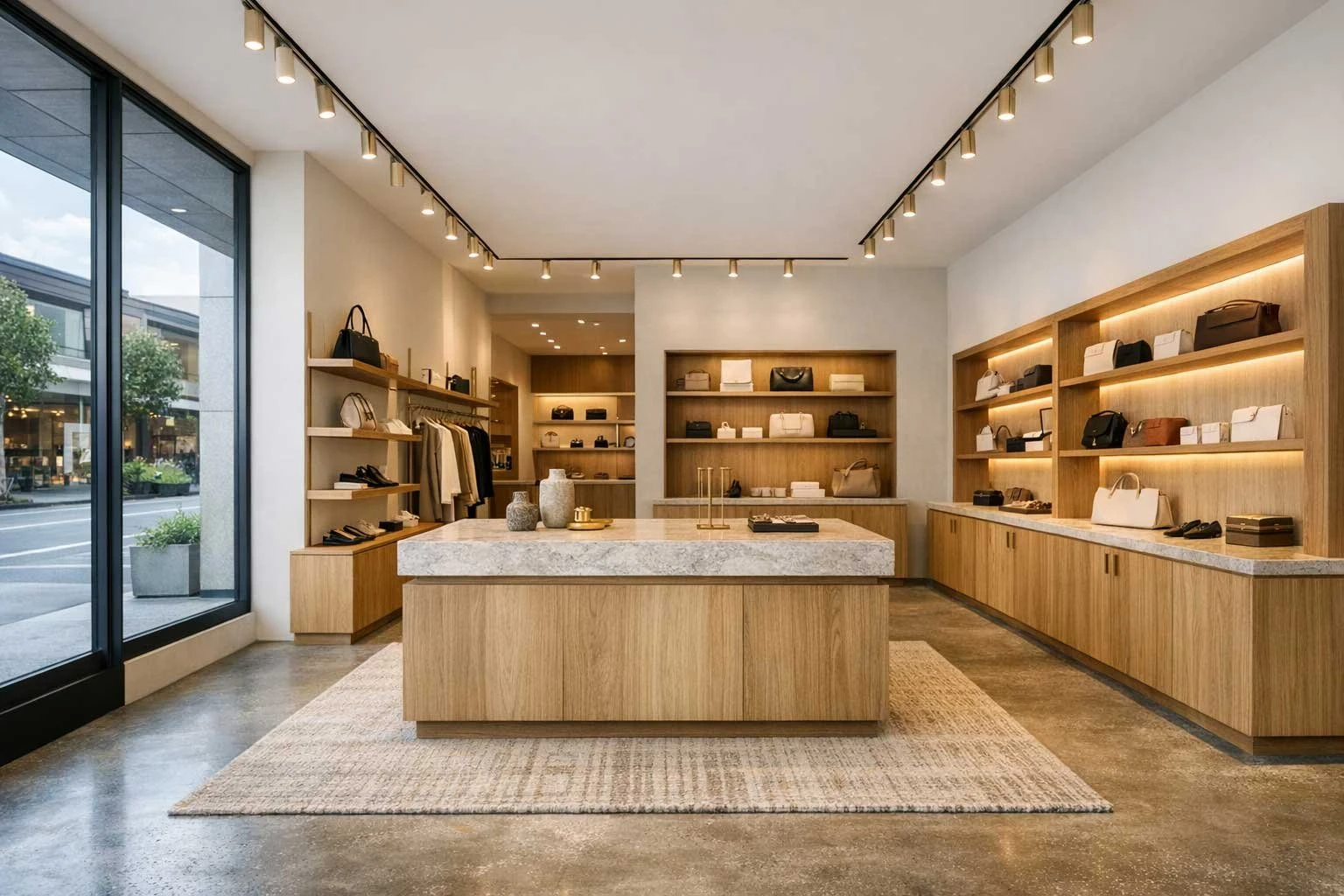
A shop fitout cost in Melbourne is set primarily by tenancy condition, fit category, and builder market rates at the time of tender. A cold shell tenancy - handed over with structural slab and base building services to the tenancy boundary only - requires significantly more trade work than a warm shell, where HVAC, electrical mains, and amenities are already in place. That single variable can shift the cost per square metre by several hundred dollars before any fitout decision is made.
A basic shopfront in a suburban strip mall and a bespoke boutique in Sorrento can both be described as retail fitouts. The gap between what they cost to build is not about size - it is about shell condition, fitout level, joinery specification, approval pathway, and the specific demands of the retail type. This post is about understanding those variables and what they mean for your budget before you commit to a tenancy or brief a designer.
Published per-square-metre figures circulate widely online. They are not useless, but treating them as quotes is one of the most reliable ways to end up with a budget that cannot build what you have designed. The actual cost of your fitout depends on too many project-specific variables for any published figure to be more than a starting point for a feasibility conversation. This guide explains what those variables are, what the Melbourne and Victoria market looks like in 2026, and how to think about your budget before any plans are drawn.
Why Retail Fitout Costs Vary So Much
Shell condition - what you are starting from
The tenancy you lease determines the floor for what your fitout will cost. The industry distinguishes between warm shell and cold shell tenancies, and the difference can account for a significant portion of the total budget.
A warm shell tenancy has core services infrastructure already installed: HVAC supply and return, electrical mains to the tenancy, plumbing rough-ins where relevant, and typically a finished ceiling grid. A fitout in a warm shell focuses on partitioning, joinery, finishes, and connecting your fitout to existing services. Most established suburban retail strips and shopping centre tenancies are delivered as warm shell.
A cold shell is structural only - the concrete slab, columns, and building envelope, with no services, no ceiling, and no lighting installed. Fitting out from cold shell means building the entire services infrastructure from scratch: HVAC systems, all electrical runs, hydraulics, data cabling, and the ceiling structure to house them. Cold shell fitouts cost materially more per square metre and require a longer construction programme. Some newer commercial buildings are delivered as cold shell even in well-established locations, which surprises lessees who did not confirm the condition before signing.
Confirming shell condition with the landlord before committing to a lease - before you are contractually bound - is one of the most useful checks a designer with retail fitout experience can make on your behalf.
Fitout level - the decision that moves the number most
Beyond shell condition, the single biggest variable in retail fitout cost is the level of fitout you are building. The market broadly recognises three tiers, and the gap between them is where most of the range in published benchmarks comes from.
A basic fitout works with the existing shell finish and uses standard, off-the-shelf fixtures and fittings. The shopfront may receive a paint or vinyl update rather than new joinery. Lighting uses standard track systems. Display fixtures are modular and sourced from commercial suppliers. This approach suits new retailers testing a concept, businesses with modest margins, or operators fitting out a space that will need to adapt frequently.
A mid-range fitout introduces custom elements: designed joinery for the counter and display units, a branded shopfront treatment, a designed lighting layout, and finishes chosen for the brand rather than from a standard catalogue. This is the most common level for established independent retailers and boutiques.
A bespoke fitout specifies everything from scratch - custom joinery designed and documented for a cabinet maker, architectural lighting, premium materials throughout, a fully designed shopfront and facade, and signage integrated into the design rather than treated separately. High-end boutiques, flagship stores, luxury lifestyle retailers, and cellar doors operating at a premium price point typically build at this level.
Joinery - why it dominates the budget
Joinery is typically the largest single line item in a retail fitout budget, and the variable that most separates a bespoke fitout from a standard one. Custom display units, a designed counter, wall-mounted rail and shelving systems, built-in seating, and display window furniture are all joinery. The gap between standard off-the-shelf units and fully designed, cabinet-maker-built joinery in the same tenancy can be very significant.
Joinery cost is driven by material selection - solid timbers and stone bench tops versus laminated board - by design complexity, and by the number of individual pieces. A boutique counter designed as a feature piece with integrated lighting and a stone top sits in a very different cost category from a standard laminate counter with a clip-on fascia. Documenting joinery to the standard required for accurate cabinet maker pricing is part of the design process. It cannot be priced accurately from a sketch or a mood board.
Street Retail vs Shopping Centre - Two Very Different Cost Profiles
Street-facing and standalone retail
Street retail - a shopfront in a suburban strip, a standalone building, or a tenancy in a mixed-use development without a shopping centre structure - gives a retailer the most design freedom. Approval requirements run through the local council only, unless the building carries a heritage overlay or a planning overlay that restricts facade treatments. There are no shopping centre management approvals to navigate, no mandatory fitout guidelines to comply with, and no fitout levy to pay.
Shell conditions in street retail vary more widely than in shopping centres. Established strips often have older buildings with legacy electrical, ageing plumbing, and in some cases asbestos-containing materials in walls, ceilings, or floor coverings. A well-located shopfront in a heritage township centre may need material remediation work before any design work can begin. The National Construction Code governs the compliance requirements regardless of building age, and any change of use or structural modification will trigger a building permit regardless of location.
Shopping centre fitouts
Retail tenancies in shopping centres operate under a layer of landlord requirements that street retail does not. Before a building permit is issued, the fitout design must be approved by centre management, who enforce mandatory fitout guidelines. These guidelines prescribe everything from partition heights and storefront glazing requirements to the signage zone design and materials palette. The intent is to maintain a consistent centre aesthetic - the practical effect is that the retailer has less design freedom than in street retail, and the approval process has an additional step that can add time to the programme.
Shopping centre leases also commonly include make-good provisions: a contractual obligation to return the tenancy to shell condition at the end of the lease term. Make-good costs - stripping joinery, patching services penetrations, restoring surfaces - can reach a material sum for a well-specified fitout, and this future liability needs to be factored into the investment calculation alongside the initial fitout cost. Some centre leases include a fitout contribution or incentive from the landlord, particularly for anchor tenants or in centres with high vacancy. This contribution offsets part of the fitout cost but comes with its own conditions and approval requirements.
HVAC systems in shopping centres are often centralised, with tenancies connecting to the centre's plant rather than installing independent split systems. This simplifies the HVAC fitout for the retailer in some centres and complicates it in others, depending on how the centre's infrastructure is configured. Confirming the services provision model with centre management before briefing a designer is an important early step.
Which costs more - and why the answer is not straightforward
Neither context is inherently more expensive. A bespoke boutique fitout in a street tenancy can cost significantly more than a mid-range shopping centre fitout in the same suburb. The cost drivers differ rather than stack in favour of one context.
Shopping centres tend to impose a higher minimum fitout standard through their guidelines - meaning the floor is higher, but so is the resulting brand presentation. Make-good obligations add a future liability that street tenancies typically do not carry. Street retail offers more design freedom and no shopping centre management layer, but shell conditions are more variable and approval pathways more project-specific, particularly in heritage areas.
The right context depends on where your customers are, what your brand requires, and what the tenancy economics look like over the term of the lease - not on a simple cost comparison.
What Melbourne and Victoria Retail Fitouts Cost in 2026
Published benchmarks for Melbourne retail fitout construction costs generally range from around $1,500 to over $3,000 per square metre, with high-specification boutiques and bespoke fitouts at the upper end of that range or beyond. These figures appear in quantity surveyor reports, fitout contractor estimates, and industry publications. They are useful for early feasibility. They are not a quote.
The gap between the low and high end of that range reflects every variable already covered: shell condition, fitout level, joinery specification, retail type, and approval complexity. A fitout that achieves $1,500 per square metre and one that achieves $3,500 per square metre can both be accurately described as retail fitouts. The figure that applies to your project depends on the specific conditions and decisions in yours - which is why the only reliable way to establish a budget is through the design process with a designer who understands the current market.
Shopfront and facade - the underestimated line item
The shopfront is the first brand impression a passing customer forms, and it is consistently one of the most underestimated line items in a retail fitout budget. The scope can range from a modest repaint and vinyl graphics update to a fully custom aluminium glazing system with integrated signage, external lighting, and facade cladding.
Where the shopfront involves changes to the existing facade structure, council consent may be required under Victoria's planning framework. Heritage overlays - common in established township centres, including several Mornington Peninsula coastal towns - impose additional constraints on what changes are permissible and may require a heritage assessment before anything proceeds. These approval requirements add time and design cost, and they need to be on the programme from the beginning, not discovered partway through.
Mornington Peninsula and regional Victoria - the distance premium and the market
Projects outside inner-metropolitan Melbourne carry a consistent cost premium relative to equivalent city fitouts. The premium is not dramatic in percentage terms on any single line item, but it compounds across several at once.
Specialist trades - electricians, plumbers, HVAC installers, glaziers - typically travel from Melbourne for Peninsula projects. Travel time is charged as a travel allowance or a day-rate loading, and the Peninsula's distance from Melbourne's outer suburbs means this accumulates across a multi-week construction programme. Materials deliveries carry a freight component that inner-metro projects do not. The pool of builders with Peninsula fitout experience who can maintain competitive pricing is narrower than in metropolitan Melbourne, which reduces tender competition.
What makes the Peninsula market particularly distinct is the character of its retail. The Peninsula's economy has a substantial tourism and lifestyle layer - luxury boutiques in Sorrento and Portsea serving an affluent visitor and permanent residential market, winery and cellar door retail operations along the Mornington Peninsula wine region that blend product sales with a brand experience, gourmet food stores and providores, and wellness retail connected to the area's spa economy. Golf courses of national significance - including The National Golf Club and Moonah Links - support a premium equipment and lifestyle retail segment. These retail categories tend to sit at the mid-range to bespoke end of the fitout quality spectrum, which means projects coming out of this market typically carry higher fitout scopes than equivalent suburban Melbourne retail.
The combination of the regional trade premium, a higher average fitout standard, and the planning considerations specific to the Mornington Peninsula Shire - including heritage overlays in coastal townships and local planning policy for commercial areas - means this market has a cost character that is best understood through a project-specific assessment rather than a metropolitan benchmark.
Fitout Costs by Retail Type
Retail is not a single category. The fitout requirements - and therefore the cost drivers - vary significantly depending on what the business sells, how customers interact with it, and what regulatory and compliance requirements apply to the operation. If you are comparing fitout types, see our pharmacy fitout cost guide or medical fitout cost guide for how specialist fitout costs compare.
Boutique and fashion retail
Boutique and fashion retail is typically joinery-intensive. Display units, rail systems, fitting rooms, a designed counter, and shopfront and window display are all bespoke at the mid-range and above. Lighting is usually the second-largest investment: product lighting in fashion retail determines how colour reads and how merchandise looks to a customer, and getting it wrong is expensive to fix after the ceiling is closed - relocating circuits and lighting tracks means reopening the ceiling structure. A boutique fitout at mid-range to bespoke level is among the more investment-intensive retail categories per square metre, because joinery and lighting together account for a high proportion of the budget.
Specialty food and grocery
Food and grocery retail introduces services requirements that most retail categories do not carry. Refrigeration systems, cold rooms, food-safe surface specifications, trade waste connections, and mechanical ventilation for food preparation areas are all additional cost items relative to a standard retail fitout. Food Standards Australia New Zealand requirements and council food safety registration apply regardless of the size of the operation. Where the retail operation includes any food preparation or hot food service, the fitout scope moves into territory that shares design requirements with the hospitality category - our hospitality fitout page covers cafe and food service design in more detail.
Health and wellness retail
Health and wellness retail - supplements, natural health products, skincare, cosmetics - typically has lower services requirements than food retail but often requires a higher finish standard, particularly for brands positioning at the premium end of the market. Where a retailer is moving toward a consultation model - a nutritionist, a skin therapist, or a health advisor working within the retail space - partitioned consultation areas with appropriate acoustic and privacy treatment add to the scope. For pharmacy-adjacent retail where a dispensary or professional service area is part of the operation, the fitout requirements overlap with the compliance and spatial standards covered in our pharmacy fitout service.
Professional services with a retail front
Real estate agencies, legal practices, financial advisers, and similar professional services businesses with a walk-in presence have a different fitout brief from product retailers. The front-of-house fitout is lighter on display fixtures and joinery than a product retailer, but workstation configuration, data infrastructure, and meeting room requirements can add cost that does not appear in a standard retail benchmark. The National Construction Code classifies most of these tenancies as Class 5 commercial, and the fitout process runs the same approval pathway as product retail.
What's Driving Costs Higher in 2026
Labour - the pressure that isn't easing
The persistent driver of construction cost escalation in Australia is not materials - it is labour. Specialist trades are among the hardest roles to fill nationally, and retail fitouts require the trades in shortest supply: electricians capable of delivering complex lighting designs and power infrastructure, plumbers for hydraulic connections, and HVAC specialists for commercial mechanical systems.
Enterprise agreements negotiated across Melbourne, Sydney, Brisbane, and Perth have locked in approximately 5% annual wage growth for construction workers for the next three to four years, according to Turner & Townsend's Global Construction Market Intelligence report. This is structural, not temporary - embedded in multi-year agreements running across the major construction markets. The Fair Work Commission's annual wage review adds further upward pressure on the lower end of the trades workforce. Master Builders Australia has consistently identified skilled trade shortages as the primary risk to project costs and timelines. RLB's Q4 2025 market intelligence forecasts 4% cost growth for the Melbourne construction market in 2026, with no meaningful easing anticipated.
Copper, HVAC, and the import cost squeeze
Copper prices have risen sharply year-on-year, with Altus Group's Australian Construction Material Price Outlook reporting a 16.5% increase year-on-year into 2026. Retail fitouts are copper-dependent in ways that are easy to underestimate: electrical cabling, lighting circuit infrastructure, HVAC refrigerant pipework, and data cabling all rely on it. The material cost of a fitout's electrical and HVAC components is meaningfully higher today than it was 18 months ago.
HVAC systems for commercial retail - particularly mid-range and bespoke fitouts requiring designed zoning - are frequently imported, and two pressures are compounding procurement costs simultaneously. US tariff changes on imported mechanical equipment and related components are feeding through into project budgets. The Australian dollar's weakness against major trading currencies multiplies the local cost impact of any imported equipment. Display fixtures, specialty hardware, and shopfront glazing systems sourced from offshore suppliers carry the same dual pressure. These cost increases are applying concurrently to several significant line items in a retail fitout budget at the same time.
Fuel and freight - the regional premium
The cost of moving materials and equipment to site has remained elevated since the supply chain disruptions of earlier in this decade. For metropolitan Melbourne fitouts, freight is a relatively minor variable. For Mornington Peninsula and regional Victoria projects, it compounds across the entire construction programme: materials deliveries, equipment transport, and the daily trade travel from metropolitan Melbourne to the project site. The ACCC's fuel monitoring data shows commercial vehicle fuel costs have remained well above pre-2020 levels. For a project running four to six weeks of active construction, the cumulative freight and travel component is material - and it does not appear in any metropolitan benchmark figure.
Hidden Costs That Catch Retailers Off Guard
Make-good obligations and shopping centre levies
Make-good provisions in retail leases - the obligation to return the tenancy to shell condition at the end of the lease - are one of the most commonly overlooked costs when planning a fitout. A well-specified fitout is, paradoxically, more expensive to make good than a basic one: there is more custom joinery to remove, more surface restoration required, and more services penetrations to cap and patch. The future make-good liability belongs in the investment calculation alongside the fitout cost, not as an afterthought when the lease ends. Consumer Affairs Victoria provides guidance on retail lease obligations in Victoria, including make-good requirements and fitout contribution arrangements.
Shopping centre fitout levies - where a centre charges the retailer a fee for fitout approval, builder access, or management of the fitout process - vary significantly between centres and are sometimes negotiable as part of the lease. Establishing these costs before lease execution is part of the commercial due diligence, not the fitout brief.
Asbestos and legacy building conditions
Buildings constructed before the mid-1980s in Australia may contain asbestos-containing materials in wall linings, ceiling tiles, floor coverings, adhesives, or external cladding. Victorian Building Authority requires that asbestos-containing materials be identified and managed before any demolition or fitout work begins. In street retail tenancies in established commercial strips - many of which occupy buildings of this vintage - asbestos identification and management can add a material cost and a time buffer that is invisible until a pre-fitout inspection is conducted. Identifying this risk before committing to a lease is significantly cheaper than discovering it once the programme has started.
Contingency - what to hold back
A contingency allowance is not pessimism - it is an acknowledgement that no project can be priced perfectly from drawings. The standard advice for commercial fitouts is to hold a contingency of at least 15-20% of the total construction budget. In current market conditions - with materials escalation, sustained labour pressure, and the potential for discovery of legacy conditions in older buildings - holding closer to 20-25% is prudent, particularly for older buildings and regional projects. A contingency that is not used is money returned to the project. One that was not held becomes a debt.
Getting the Most From Your Retail Fitout Budget
The most reliable way to protect a retail fitout budget is to resolve the design before construction starts. This sounds straightforward, but it is the step most often compromised under pressure from a lease commencement date. Incomplete or undocumented designs are consistently the primary cause of fitout cost overruns - because variations during construction are priced at a premium over the original tender rate, and because incomplete documentation makes it impossible for builders to price accurately and competitively.
Design Yard 32's approach to retail fitout separates the design and documentation process from the construction entirely. We produce the full set of design drawings, joinery documentation, finishes specifications, and approval submissions that your builder needs to price the project accurately. You take that documented design to multiple builders, compare their prices on equal terms, and choose who builds it. This is the model that produces the most competitive construction pricing - because builders are quoting the same defined scope, not estimating different versions of an incomplete brief.
Our retail fitout design service covers space planning and customer flow, 3D concept design and visualisation, bespoke joinery design, shopfront and facade documentation, approval submissions, and the full working documentation package from concept through to building permit. Get in touch to discuss your project and timeline.