Pharmacies face a compliance burden that goes well beyond a standard retail fitout. Before a single prescription can be filled at new premises, multiple government bodies need to be satisfied - each with their own documentation requirements, standards, and approval processes. For an independent pharmacy owner, understanding what those layers are and how they connect to your fitout drawings can be the difference between a smooth approval and months of costly rework.
This post sets out the pharmacy design compliance framework in Australia, with a focus on Victoria. It is written for independent pharmacy owners planning a new pharmacy, a relocation, or a significant renovation. If you are specifically renovating an already-registered pharmacy, our guide to renovating a registered pharmacy in Victoria covers the VP21 alteration process and sequencing in detail.
The Three Compliance Layers That Affect Your Pharmacy Design
Pharmacy premises compliance operates across three distinct levels.
The first is federal. The Pharmacy Board of Australia (operating through AHPRA) sets professional practice standards all pharmacists must meet. While these are professional standards, not building codes, they directly shape how a pharmacy space needs to function - how counselling areas work, how the dispensary workflow is structured, and how clinical activities are managed within the premises.
The second is state-based. In Victoria, the Victorian Pharmacy Authority (VPA) regulates pharmacy businesses under the Pharmacy Regulation Act 2010. The VPA must register your premises before you can legally operate a pharmacy there. This approval is separate from - and in addition to - your council building permit.
The third is building and construction. Your fitout must comply with the National Construction Code (NCC), which sets the building classification, fire safety, accessibility, and structural requirements for the physical space. A registered building surveyor - either council or private - issues the building permit against the NCC.
All three layers produce documentation. All three need to be addressed during the design stage.
VPA Premises Registration - What the Approval Actually Requires
Before the VPA will register your premises, it must be satisfied that the premises are suitable for the provision of pharmacy services and that they comply with the Pharmacy Regulation Act 2010, the Schedule, and the VPA Standards.
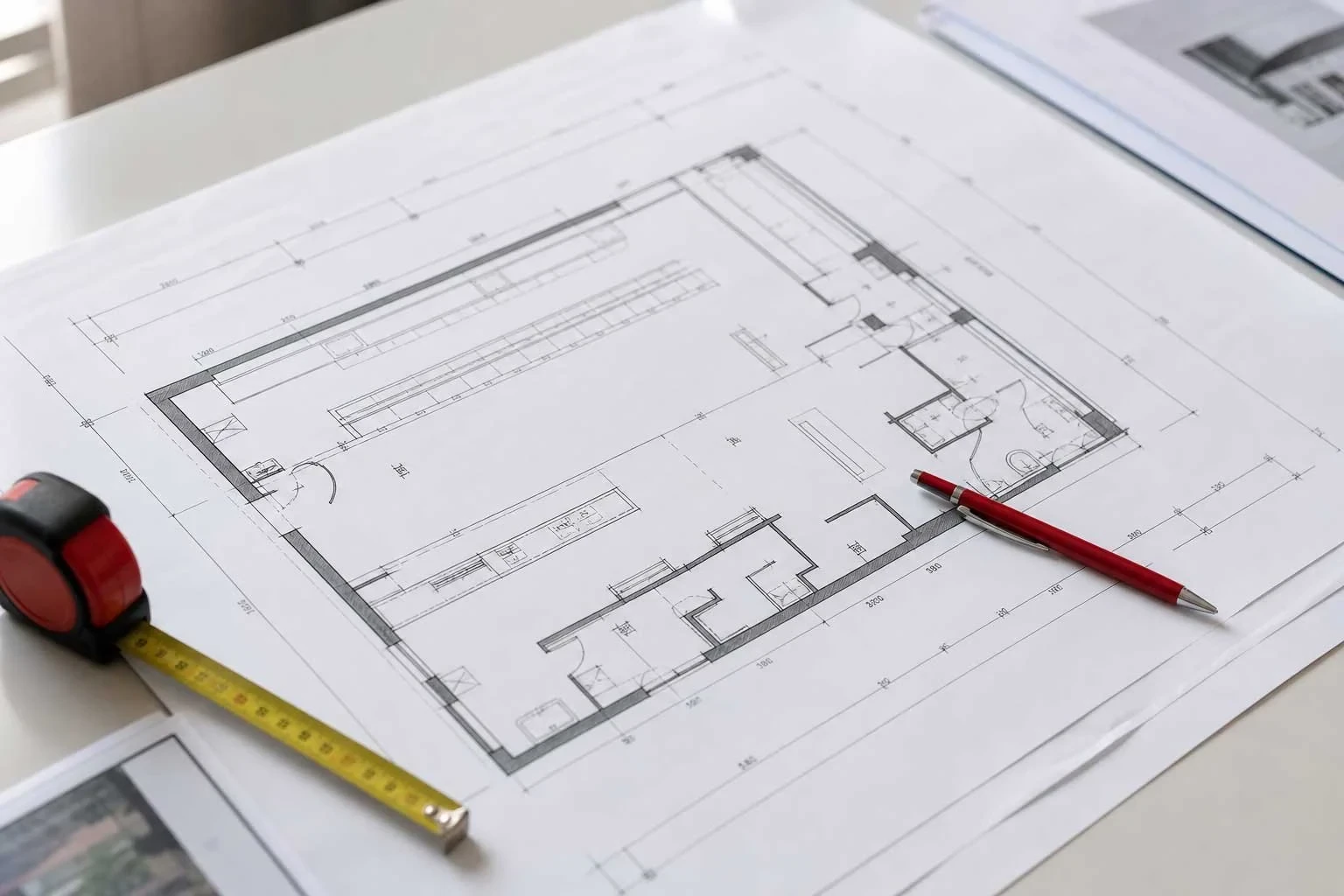
To make that assessment, the VPA requires you to submit a scaled floor plan as part of your registration application. The floor plan is not a formality - it is the primary evidence the VPA uses to evaluate whether your application meets the standard.
The VPA has published four sample floor plans to guide applicants. They are explicit that there is no single preferred layout, but that every plan must be to scale and must demonstrate the relevant regulatory requirements have been met. Incomplete applications delay assessment and typically generate requests for amended plans before the assessment can continue.
What Your Floor Plan Needs to Demonstrate
The VPA Standards (gazetted May 2022) set out what the physical premises must include. Several of these requirements are direct design decisions - not features you can add after construction.
Dispensary Design and Workflow
The dispensary is the operational core of the pharmacy and its layout is assessed as part of your VPA submission. The design must support safe dispensing practices - including a defined dispensing area, appropriate storage for prescription medicines, and a workflow that supports checking and verification steps. Getting the dispensary layout right from the start also has a direct impact on how efficiently pharmacists can work day to day. That starts with choosing the right model for your pharmacy, see our comparison of traditional vs forward dispensing.
Counselling and Consultation Area
Pharmacies must have a dedicated area for patient counselling - a private or semi-private space where pharmacists can discuss medicines, health matters, and clinical information with patients. The design of this area, including its acoustic and visual privacy, needs to be resolved at fitout stage, not improvised with a screen after opening.
Schedule 8 Controlled Substance Storage
Pharmacies holding Schedule 8 (S8) medicines - morphine, oxycodone, and other controlled substances - face specific storage requirements under Victoria's controlled substances legislation. S8 medicines must be kept in an approved drug safe. The VPA publishes a reference guide on managing Schedule 8 poisons that covers what storage must include and how it must be maintained.
The safe needs to be positioned, anchored, and integrated into your dispensary at the right stage of construction. For pharmacies whose S8 volumes have grown past what a drug safe can handle, the decision between a safe, strong room, or purpose-built vault also needs to be resolved at design stage - our guide on Schedule 8 storage for pharmacies covers how those decisions interact with the approval and fitout process.
Security, Staff Areas, and Zone Separation
The VPA Standards address security requirements for the dispensary and medicine storage areas. The premises also require clear separation between public-access and staff-only zones, with appropriate staff amenities. These separations must be designed into the floor plan - they cannot be created with temporary partitions after construction is complete.
NCC Building Classification - Retail or Something Else?
Under the National Construction Code, a standard community pharmacy is classified as a Class 6 building - the same class as a shop or service premises. This classification governs fire safety, structural requirements, exits, and accessibility provisions.
If your pharmacy includes a consulting room where patients receive clinical services with a degree of care or supervision beyond a standard counselling conversation, the classification of that space needs to be confirmed carefully at design stage. A space that should be classified differently from Class 6 - but is not - creates a compliance problem that is expensive to resolve mid-permit or mid-construction.
Getting the NCC classification confirmed early defines the building permit pathway and avoids delays downstream.
Accessibility - Planned In, Not Added Later
Any premises open to the public must comply with Australia's national accessibility requirements for buildings. For a pharmacy, this means the dispensing counter, counselling area, and all public circulation paths need to be assessed at design stage. Accessible service counters, doorway clearances, and toilet provisions are all part of the NCC compliance package.
Accessibility requirements most often create surprises in existing tenancies with structural constraints - a heritage building, a narrow shopfront, or a low-ceilinged space. Identifying access issues at design stage avoids having to redesign after a building permit has been submitted.
Pharmacy Board Guidelines - A Change Coming in October 2026
The Pharmacy Board of Australia is replacing all its current practice-specific guidelines with a single consolidated document from 1 October 2026. The existing dispensing, practice-specific, and proprietor guidelines expire on 30 September 2026 and are replaced by new "Guidelines on the safe provision of pharmacy services including medicines and advice."
If your fitout involves design decisions linked to those guidelines - how the counselling area functions, how the dispensary workflow is structured, or how clinical activities are separated - confirm you are working against the version that will be current when you open. Check the Pharmacy Board's codes and guidelines page for the current document as you approach your opening date.
What the Designer Produces and What You Still Need to Handle
A designer's job in a pharmacy fitout is to produce the drawings and documentation that satisfy each compliance layer. In Victoria, that means a scaled floor plan ready for your VPA premises registration application, NCC-compliant drawings for the building permit, and a design that incorporates accessibility requirements from the start.
What a designer does not do is submit your VPA application, hold your pharmacy licence, or manage your AHPRA registration. Those obligations rest with you as pharmacist-proprietor. The designer produces the documentation; you use it to complete your regulatory applications.
This is also why design decisions made early are less expensive than changes made late. A floor plan submitted to the VPA that does not meet the Standards requires amendment before the assessment can continue. A permit application with an incorrect NCC classification creates delays with the building surveyor. For a detailed picture of what a pharmacy fitout involves from a design and cost perspective, see our guide on how much a pharmacy fitout costs in Australia. DY32's pharmacy compliance service covers the documentation side of all three layers, and you can see the full scope of our work on the pharmacy fitout page.
DY32 works with pharmacy owners across Australia. While this post focuses on Victoria's VPA framework, the design approach - a scaled floor plan that addresses your state's specific regulatory requirements - is the same wherever you are.