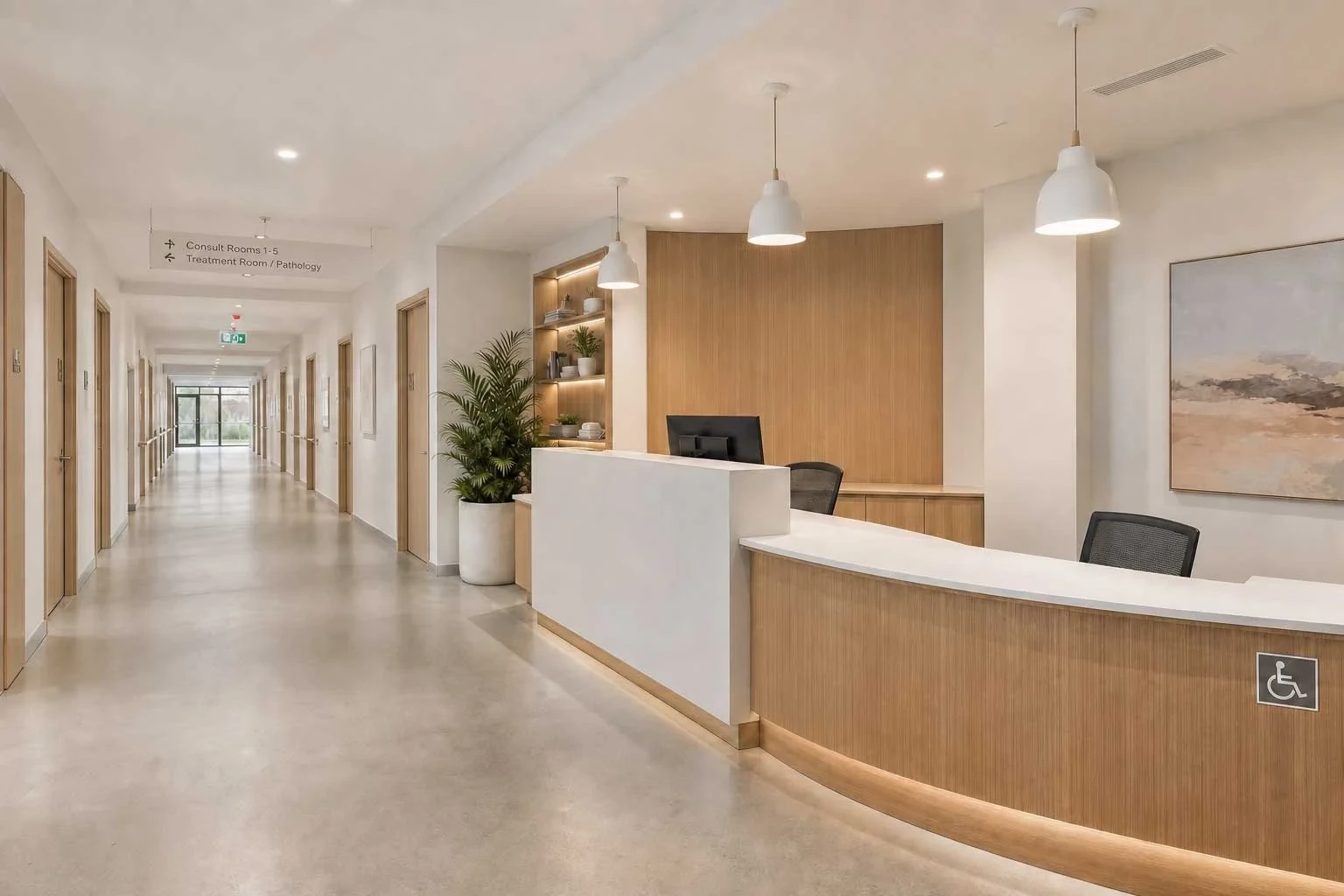
When a GP practice owner asks about compliance for a medical fitout, they usually expect one answer. What they get - and what they need - is three. A medical fitout in Australia sits under three separate compliance frameworks, each with different legal standing, different triggers, and different enforcement mechanisms. The National Construction Code sets the building requirements. Federal accessibility law sets baseline access standards for patients. The RACGP's practice standards set the clinical and physical premises requirements tied to accreditation. None of these frameworks references the others directly. Getting a compliant clinic means understanding how all three apply, how they interact, and where the gaps are most likely to appear. In Victoria, these obligations now sit under NCC 2025, which took effect on 1 May 2026.
Three Separate Compliance Layers
A medical fitout does not have a single compliance document. It has three distinct frameworks that apply simultaneously.
The first is the National Construction Code - the building code. The second is the federal accessibility standard for buildings, which sits under the Disability Discrimination Act 1992. The third is the RACGP's standards for general practices, which govern accreditation. Each framework is triggered differently, enforced differently, and requires different expertise to navigate. A builder and building surveyor handle the NCC. An accessibility consultant may assist with the DDA requirements. A designer who understands GP clinic layout and accreditation is needed for the RACGP layer. Understanding who owns each layer - and ensuring nothing falls between them - is where compliance gaps most often form.
The National Construction Code and How It Applies to GP Clinics
The National Construction Code (NCC) is the primary building standard in Australia. It governs structural safety, fire safety, accessibility, energy efficiency, and amenity for all building work that requires a building permit. In Victoria, NCC 2025 - the current edition - came into force on 1 May 2026. Practices fitting out or carrying out building works in Victoria from that date are working under NCC 2025 and the Victorian Building Authority's amended state variations. Practices in New South Wales and Queensland remain under NCC 2022 until May 2027.
Building classification - why it shapes almost everything
The NCC applies differently depending on how a building is classified. The classification that applies to your clinic affects fire safety requirements, accessibility obligations, structural requirements, and the complexity of the permit process. For most GP clinics, the relevant classification is Class 5 - a professional and commercial office building - which applies to ambulatory practices where patients arrive, consult with a GP, and leave. Class 9a applies to health-care buildings where patients need care that prevents them from leaving unassisted, typically day surgery, endoscopy suites, or facilities where patients receive procedural sedation and require supervised recovery on site. The classification is not chosen by the practice owner. It is determined by what the space is designed to do. A GP clinic that only runs ambulatory consulting is Class 5. A clinic that adds a specialist procedure room for minor surgery under sedation may require a different classification for that space.
Getting the classification wrong at permit stage is one of the most significant compliance risks in medical fitouts. A space classified too low may not meet the structural, fire egress, or ventilation requirements needed for the intended use. A fitout proceeding under an incorrect classification can require expensive rectification after the permit is issued - or fail to achieve RACGP accreditation because the premises do not match what the accreditation standard expects.
NCC 2025 changes that affect GP clinics in Victoria
NCC 2025 introduced updated energy efficiency requirements for Class 5 to 9 buildings. For Victorian practices fitting out in 2026, this means building fabric, glazing, artificial lighting, and HVAC systems must meet the commercial energy efficiency provisions of the current code. This is not unique to medical fitouts - it applies to all commercial fitout work in these building classes - but it is a dimension that a general commercial builder unfamiliar with the medical sector may not flag unless specifically briefed. For practices starting fitout planning now, the energy provisions should be part of the design brief from the first meeting, not a discovery at permit documentation stage.
Accessibility Requirements and When They Are Triggered
Australia's national accessibility requirements for buildings are set by federal law. The current standard - as amended in November 2024 - applies to new buildings and to significant alterations to existing buildings. For a GP practice, this matters most when a fitout involves substantive changes to the structure, layout, or function of the tenancy.
What counts as a significant alteration
The standard does not require a complete accessibility upgrade every time a clinic repaints walls or installs new joinery. It does apply when work constitutes a significant alteration - changes that materially affect the fabric or layout of the building. A full tenancy fitout in a new or existing space will typically trigger accessibility compliance. The consequence is that the fitout must provide an accessible path of travel from the building entrance to the clinic reception, accessible parking where parking is provided, accessible sanitary facilities, accessible signage, and hearing augmentation where required by the standard. For a GP clinic, which sees a cross-section of the general population including patients with mobility limitations and chronic health conditions, accessibility compliance is both a legal obligation and a practical clinical necessity. Most patients who need an accessible path are not using a wheelchair - they are managing reduced mobility, balance impairment, or recovering from a procedure. The clinical case for accessible design in general practice is straightforward.
Where GP clinics commonly fall short
The most frequent access gaps in GP fitouts in existing commercial buildings are: no accessible path from the street to the reception desk, sanitary facilities that do not meet dimensional requirements, step or ramp transitions that comply visually but not to the technical standard, and waiting areas that do not allow adequate circulation for mobility equipment. These are not issues that a skilled builder overlooks intentionally - they arise when the brief does not specify accessibility compliance explicitly, or when the designer has not mapped the access path end to end before construction begins. Finding an access gap during an accreditation assessment or after a complaint is filed is far more expensive than designing to standard in the first place.
RACGP Standards - the Compliance Layer Most Owners Overlook
The RACGP's standards for general practices (5th edition) are not legislation. They are a voluntary framework that general practices choose to be assessed against. Calling them voluntary understates their practical significance. Accreditation against the RACGP standards - or current registration for accreditation - is required to apply for the Practice Incentives Program (PIP) administered by Services Australia. PIP provides practice-level financial incentives that most GP clinics rely on to sustain bulk billing and rostered staff. Accreditation is also a condition for participation in the Workforce Incentive Program Practice Stream and is increasingly connected to MyMedicare practice registration. The standards are voluntary in a technical sense. The financial consequences of not being accredited make them mandatory in practice.
What the RACGP standards require of physical premises
The RACGP's premises requirements cover the physical environment of the clinic - not just the clinical processes. They include: consulting room design that provides adequate privacy and sufficient space for examination and clinical documentation, accessible entry and circulation for patients with disabilities, the physical layout of sterilisation and clinical waste management, handwashing and personal protective equipment provisions within clinical areas, and waiting area design that separates patients with respiratory illness from the general waiting population. These are assessed during an accreditation visit by one of four independent accreditation agencies. A practice that has invested in a fitout without accounting for these requirements can find, at accreditation, that changes are needed to the very rooms that were just constructed. Some of those changes - such as modifying consulting room dimensions, repositioning hand basins, or altering clinical waste management pathways - may require additional building work after the fitout is complete. For a deeper look at how these layout decisions play out in GP clinic design, our guide to GP clinic design and fitout planning covers the spatial and clinical requirements in more detail.
The RACGP also publishes infection prevention and control guidelines that are incorporated into the accreditation assessment. These guidelines have direct implications for fitout design: the location and specifications of hand hygiene stations, the separation of clean and contaminated workflows, the requirements for sterilisation areas, and the ventilation and surface finish provisions for procedure rooms. A designer who is not familiar with these requirements will not design them in by default. They are not covered by the NCC or by the accessibility standard - they are specific to the accreditation framework and must be built into the design documentation from the outset.
Where the Three Frameworks Intersect
The NCC, the accessibility standard, and the RACGP requirements each cover accessibility, but from different angles and at different levels of detail. The NCC sets the minimum structural access path. The federal accessibility standard sets dimensional and facilities requirements for the building. The RACGP adds patient experience and clinical workflow requirements that neither of the first two frameworks addresses. A consulting room that meets the NCC's minimum area requirement may not meet the RACGP's premises criteria for a standard examination room. An accessible toilet that complies with the federal building standard may not meet the RACGP's additional provisions for patient dignity in a clinical setting. A fitout that satisfies the builder and the building surveyor may still fail an accreditation assessment. These frameworks reinforce each other in intent but they do not replace each other. Coordinating compliance across all three is the design task, not a checklist that can be completed separately for each.
For a broader overview of what a full medical fitout involves from planning through to opening, our complete guide to medical fitouts in Australia covers the project scope, costs, and key decisions in detail. If you are at the planning stage and want to discuss what a compliant fitout brief looks like for your clinic, our medical centre fitout page covers how we approach design and documentation for GP and specialist practices.
Common Compliance Failures in GP Fitouts
The compliance gaps that create the most disruption in GP fitout projects tend to follow patterns. Misclassification at the permit stage - where a space intended for minor procedures is classified as Class 5 rather than assessed for Class 9a - surfaces late in construction and requires either a permit amendment or a change in the approved use of the space. Accessibility gaps discovered during an accreditation pre-assessment require rectification that was not in the original construction budget. RACGP premises requirements that were not part of the design brief require room modifications after handover. Energy efficiency provisions in NCC 2025 that were not part of the initial design specification require design changes at the documentation stage, delaying permit lodgement. None of these failures is unusual and none is inevitable. They share a common cause: a fitout brief that did not account for the full compliance picture before design work began.
A Note on State Variations
The compliance frameworks above apply nationally, but the NCC version in force differs by state. Victoria moved to NCC 2025 from 1 May 2026. New South Wales, Queensland, and South Australia remain on NCC 2022 until at least May 2027. For Western Australia, the ACT, Tasmania, and the Northern Territory, adoption timelines and transition provisions vary - confirm the current edition with your designer or building surveyor before documentation begins. The accessibility standard and the RACGP requirements apply nationally without state variation. For practices fitting out in Victoria, the energy efficiency and sanitary facility provisions of NCC 2025 apply now.
Getting compliance right across all three frameworks starts with the brief, not the building inspection. If you are planning a GP clinic or medical fitout in Australia, our medical centre fitout service covers our approach to design and documentation. You can also contact us directly to discuss your project.