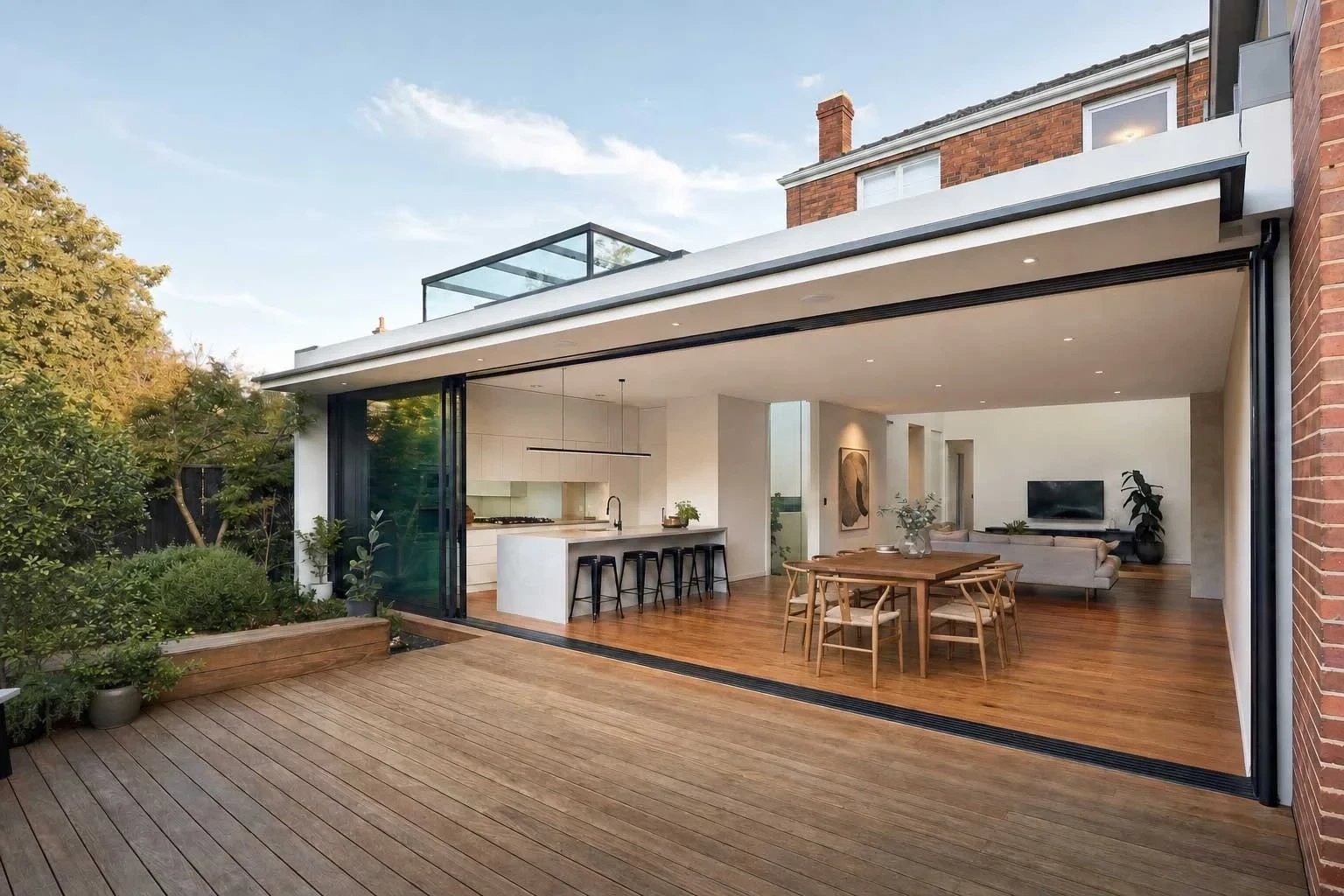
Most of the guides to home extensions in Melbourne focus on permits, process, and cost. Those are important questions - and we cover them in detail in our guide to planning a home extension in Melbourne. But before any of that, there is a set of design questions that determines whether the finished extension actually works well.
Those questions are about orientation, not just floor plans. They are about how new connects to old, how natural light reaches the back of the existing house, and how the indoor space relates to the garden. Settling these questions before you engage a builder - or even before you finalise your brief - is the most direct path to an extension you will still be happy with in ten years.
This guide works through the design decisions that matter most. It covers site orientation, extension types from a design standpoint, the indoor-outdoor connection, how to approach period homes, and how light and ventilation shape the plan. The permit and cost questions are in the companion guide - this one is about the design. For a guide to the pre-build sequence itself - from the first design meeting through to documentation, permits, and builder appointment - see what actually happens before a builder starts your extension.
Start with the Site, Not the Floor Plan
The single most useful thing a designer does before drawing anything is analyse the site. Not just its dimensions and setbacks - those come later - but its orientation, its solar access, its wind exposure, and the existing features that either help or constrain the design.
Orientation matters more for an extension than for almost any other residential project type because extensions are almost always about living areas - the part of the house where you want warmth in winter, shade in summer, and good natural light all year round. In Melbourne, at latitude 37 degrees south, north-facing rooms receive direct sunlight through the low winter sun. East-facing rooms get morning light but lose it quickly. West-facing rooms are bright in the afternoon but can overheat in summer. South-facing rooms receive no direct sun at all.
Most Melbourne suburban blocks run east-west, which means the rear boundary faces either north or south. When the rear garden faces north, a rear extension has a clear path to good solar access. When it faces south, the designer needs to work harder - through roof forms, side setbacks, or the placement of openings - to bring useful winter light into the living spaces.
Site analysis at this stage also looks at the prevailing winds. Melbourne's summer winds tend to come from the north and north-west. Winter winds are mainly from the south and south-west. Understanding the wind paths across your specific block tells a designer where to locate openings for cross-ventilation, which parts of the outdoor area are sheltered, and whether any proposed alfresco areas will be usable or windswept.
Existing trees are worth noting early. A large established tree to the north of the proposed extension casts winter shadows and can affect how the designer approaches glazing and roof form. If the tree is protected under the council's planning scheme, removal may not be an option, and the design may need to work around it.
This site analysis - orientation, solar access, winds, views, existing features - is the foundation from which the floor plan and the roof form follow. Skipping it leads to extensions that are bright in the renders and dark in reality.
Extension Types and What Each One Offers
Our guide to home extensions in Melbourne covers the basic categories: rear, side, wrap-around, and first-floor additions. The design question is not just which type fits the block, but which type works best for what you are trying to achieve.
A rear extension is the most common choice, and for good reason. When the rear garden faces north, a rear extension has the best opportunity to capture winter sun and create a strong indoor-outdoor connection. The main design risk with a rear extension is what happens to the rooms at the back of the original house. Extending too deep into the block without careful planning of the floor plan can create a dark zone at the junction - rooms that used to look out over the garden and now look into the extension. This is covered in more detail in the section on light and ventilation below.
Side extensions suit blocks where the side setbacks allow expansion - corner blocks particularly, or wider suburban lots. From a design standpoint, a side extension is often more appropriate for functional zones such as a bedroom, bathroom, laundry, or study, because the amount of north light available on a side elevation is typically limited. The exception is a corner allotment where the side boundary has a northern aspect, which gives more design flexibility.
A wrap-around extension combines a rear component with a side component to maximise the available ground floor area. The design challenge is managing natural light to the centre of the plan, where the two wings join. This usually requires a light well, a void above the junction, or glazed roofing - something that prevents the central area from becoming a permanently dim internal zone. A wrap-around that works well is one where the designer has resolved this light path before the floor plan is finalised.
First-floor additions are a genuinely different project with different structural, planning, and cost considerations - not simply a larger version of a single-storey extension. We cover them separately in our second storey addition guide.
The Indoor-Outdoor Connection
For a rear extension, the connection between the internal living area and the garden or deck is usually the most consequential single design decision. Getting it right means the inside and outside feel like one space when the doors are open. Getting it wrong means a door you never open because it is a step down, faces into a fence, or lets in the cold.
The floor level threshold is one of the first decisions. A flush transition between inside and out - where the floor of the extension and the surface of the deck or patio are at the same level - makes the space feel continuous and the indoor area feel larger. Achieving this requires planning the floor level of the extension, the drainage falls, and the deck construction together, not as separate decisions at different stages.
Door type shapes how the opening works in practice. Bifold doors create a full-width opening but fold into a stack that takes up floor space on one or both sides when open. Stacking sliding doors open wider with less stacking space and seal better thermally, but typically cost more. A single large pivoting door or a pair of French doors can work well on a smaller opening where a large clear span is not the priority. Each option trades off differently on clear opening width, cost, thermal performance, and how the space reads when the doors are closed.
The alfresco area deserves as much design thought as the interior. An uncovered deck that faces north-west in Melbourne will be unusable in summer afternoons without shade - either a pergola, a fixed sail, or a roof extension. A covered alfresco to the south or south-west may feel sheltered but will receive very little direct sun for most of the year. Where the alfresco is located, how it is oriented, and how it is covered all affect how often it actually gets used.
Privacy from neighbouring properties is worth addressing at the design stage rather than after. If the extension opens directly to a view of the upstairs window next door, the doors will stay closed. Fencing, screen planting, or a raised deck with a balustrade can resolve privacy issues, but these are far easier to design in from the start than to add once construction is finished.
Connecting New to Old - Period Homes and the Design Challenge
Melbourne's residential stock is one of the most varied in Australia. Victorian terraces, Edwardian villas, Californian Bungalows, and Inter-war brick homes sit on the same streets as 1960s brick veneers and 1970s weatherboard houses. When you extend a period home, the question of how new relates to old is unavoidable.
There are three broadly defensible approaches. The first is to match - to use materials, roof pitch, window proportions, and detail that replicate the original building closely enough that the extension reads as part of the same house. Done with care and quality materials, this can work very well. Done poorly, it produces something that looks neither old nor new.
The second approach is to contrast - to make the extension read clearly as a contemporary addition. A flat-roofed or skillion extension in a material palette that is deliberately different from the original (steel, glass, or dark-toned cladding against original red brick) makes no attempt to blend in. When the architecture of the extension is resolved and considered, this approach is entirely defensible - and it is honest about what is original and what is new. Heritage guidelines in many councils actively support the contrast approach on the grounds that it preserves the legibility of the original structure.
The third approach - and often the most practical - is to mediate. A contemporary extension that uses a quiet, neutral material palette, neither replicating the original nor aggressively contrasting with it, can sit alongside a period home without competing with it. A skillion roof that steps down in height from the original roofline, a brick that matches the tone of the existing but not the texture, or a rendered form in a complementary colour are all examples of this.
The junction between old and new is where poor design shows most clearly. A glazed link or short connection between the original house and the extension - a light-filled transition that reads as a deliberate join rather than two different design languages colliding at a shared wall - is one of the most effective ways to resolve this. It makes clear that the extension is a new addition, and it allows light into the zone where the two parts of the house meet.
Where a heritage overlay applies to the property, the approach to the old-new junction is not purely a design preference. Victoria's planning scheme heritage requirements set the framework within which the design must work. In some overlay areas, a heritage consultant's advice is required as part of the planning permit application. Understanding the overlay type and the council's specific heritage policy before concept design begins will save significant revision later.
Light and Ventilation
A well-designed extension improves the natural light in the whole house, not just the new rooms. A poorly designed one can create a darker version of what was already there. The difference comes from how the designer handles the junction between old and new, and how the floor plan is laid out in relation to the sun.
The dark zone problem arises when a rear extension is deep - typically more than four to five metres - and the rooms at the back of the original house had windows that now face into the extension rather than the garden. A room that previously looked out to the yard is now a room that looks into a corridor or another room. Without a design response, these rooms become permanently dim. The usual solutions are a skylight or glazed roof over the transition zone, a void or light well above the junction, or a floor plan arrangement that ensures the original rear-facing rooms retain contact with another source of natural light.
North-facing glazing is the most useful passive solar tool in a Melbourne extension. A well-placed bank of windows or doors on the northern face allows low winter sun to reach deep into the floor plan, warming the space and reducing heating loads. In summer, when the sun is higher in the sky, the same windows can be shaded by a calculated eave overhang - typically 600 to 900mm in Melbourne depending on the eave height and floor level. This is not a rule of thumb but a calculation based on the sun angle at your specific site, which a designer should work through as part of the design.
Skylights and roof windows are useful for zones that cannot receive natural light from a wall opening. A flat rooflight provides diffuse reflected light. A north-facing rooflight at an angle delivers meaningful solar gain in winter and, if it is operable, can also assist with ventilation. Tubular skylights are a practical option for small internal zones where a full skylight is not possible.
Cross-ventilation is achieved by placing openings on opposite sides of the plan so that air can flow through the space. In a rear extension, the rear doors open to the garden. Windows or high-level openings on the side walls or in the roof allow air to exit. The path air takes through the floor plan matters - an open-plan layout cross-ventilates much more readily than a series of separate rooms with closed doors.
The National Construction Code's energy efficiency requirements apply to new residential work, including extensions where new habitable rooms are added. An energy efficiency assessment is part of the building permit documentation. Rather than treating this as an administrative requirement, a good designer uses it as a design tool - the assessment confirms that the proposed glazing areas, eave depths, and insulation levels meet the standard, and it shapes the design decisions before documentation rather than after.
What the Design Documentation Covers
The design process starts with a thorough brief - a structured conversation about how you use your home today, what is not working, and what you want the extension to achieve. The brief informs the site analysis, which in turn shapes the concept design.
Concept design produces floor plans, elevations, and a 3D model that show how the extension will look and feel before any commitment to construction. This is where the orientation decisions, the extension type, the indoor-outdoor connection, and the old-new junction are resolved. Changes at concept stage cost nothing beyond the designer's time. Changes after construction has started cost significantly more.
Design documentation packages the concept into a set of drawings and specifications that a builder can price accurately: dimensioned plans, a materials and finishes schedule, joinery drawings, lighting and electrical layouts, and a specification of all fixtures and fittings. The quality of this documentation directly affects the quality of builder quotes and the number of variations during construction. Our residential design services and process page explains each stage in full.
If you are ready to talk through your extension project, our residential design page outlines the services we offer and how to start the conversation.