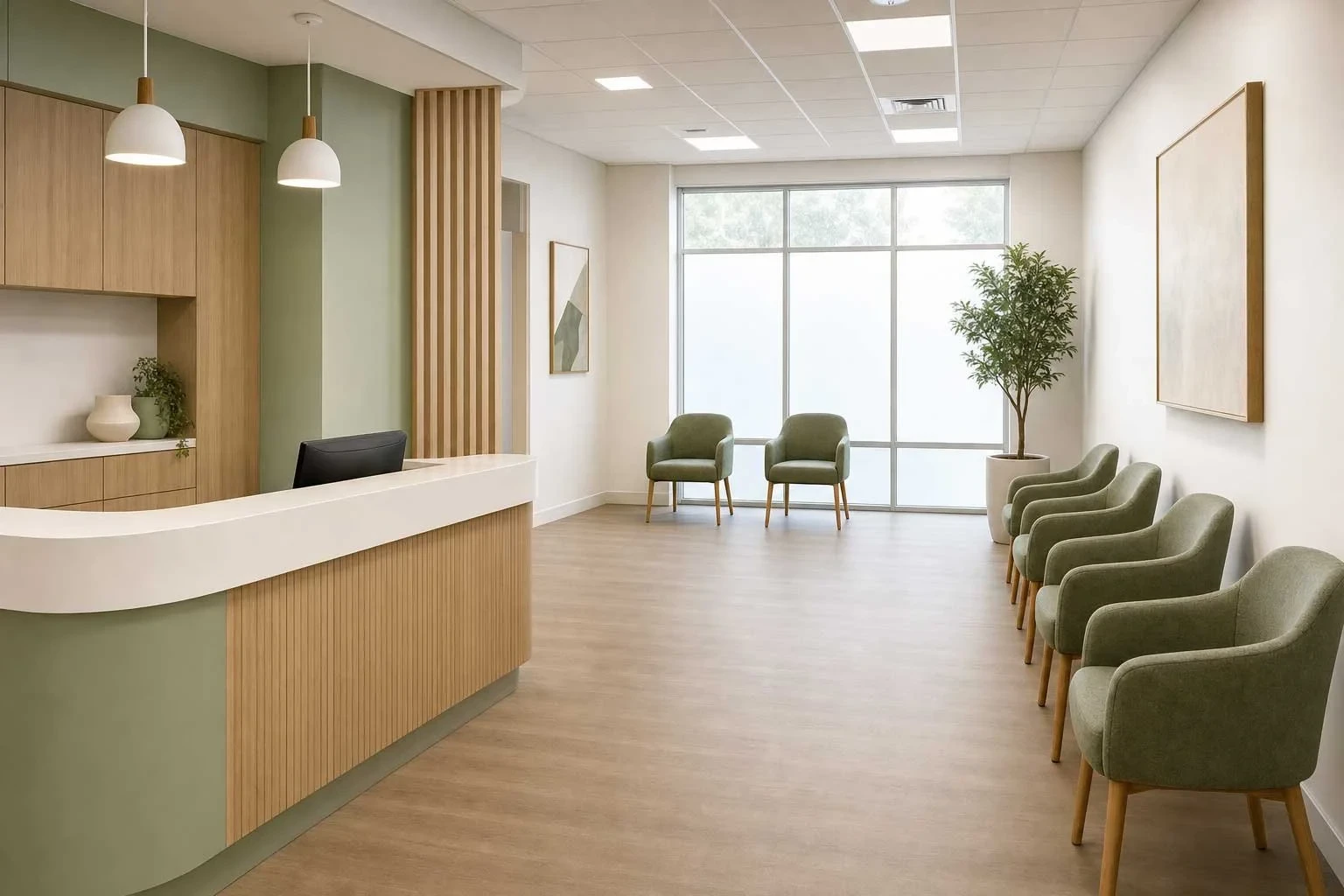
Whether you are fitting out your first physiotherapy practice, relocating an occupational therapy clinic, or expanding a multi-discipline allied health centre, the decisions made at design stage have a long reach. An allied health clinic fitout sits at the intersection of building compliance, clinical function, infection control, and patient experience - and the requirements differ meaningfully from a standard commercial tenancy fitout.
AHPRA registers more than a dozen allied health disciplines in Australia - physiotherapy, occupational therapy, psychology, podiatry, chiropractic, osteopathy, speech pathology, audiology, and others. Each brings different space requirements, different infection control needs, and different acoustic demands to the design brief. Getting these wrong during the fitout means working around structural and spatial constraints for the life of the lease.
This guide covers the compliance obligations, design decisions, and discipline-specific requirements that shape an allied health fitout from the ground up.
Allied Health Clinics and the National Construction Code
Most private allied health clinics - physiotherapy, occupational therapy, psychology, chiropractic, podiatry, and speech pathology practices - classify as Class 5 buildings under the National Construction Code. A Class 5 building is defined as an office building used for professional or commercial purposes, and it covers ambulatory healthcare settings where patients arrive, receive treatment, and leave under their own capacity. Designing and constructing for Class 5 is different from - and in several areas less demanding than - the alternative.
Class 9a applies to health-care buildings where the predominant treatment renders patients non-ambulatory and requires supervised medical care on the premises for some time after treatment. Day surgery centres and procedure units using general anaesthesia or deep sedation are the clearest examples. A standard allied health clinic - including one offering manual therapy, electrotherapy, exercise rehabilitation, or psychological assessment - does not meet this threshold. Misclassifying a fitout as Class 9a adds cost and complexity without improving safety or clinical outcomes.
The NCC classification affects fire compartment requirements, exit provisions, and the level of building surveyor documentation required. Your building surveyor confirms the correct classification for the specific works and premises. For a comparison of how classification applies across different primary healthcare settings, our guide to GP clinic design covers the same NCC framework in the context of general practice.
Planning Permits, Change of Use, and Building Permits
In Victoria, two separate approval processes apply to most clinic fitouts: a planning permit from your local council and a building permit from a registered building surveyor. They are independent processes, and neither substitutes for the other.
A planning permit is required when the proposed use of the premises constitutes a change of use under the local planning scheme. "Medical centre" is a defined land use in Victoria's planning provisions, and if the tenancy has not previously operated as a medical centre, a planning permit will typically be needed before fitout works commence. The specific requirement and assessment criteria vary by zone - a Commercial 1 Zone tenancy in a suburban strip shop and a mixed-use building in a fringe commercial precinct are assessed under different conditions. Other states and territories have equivalent planning scheme controls under different names and processes.
A building permit is required for the construction works themselves: partitioning, plumbing, electrical, and any structural modifications. The building permit is issued by a registered building surveyor who confirms the works comply with the NCC. For a change of use even without significant physical works, a building permit may still be required to confirm the existing building's compliance for the new use.
The planning permit process in particular can extend the project timeline considerably for sites that need one. Confirming the permit pathway with council before finalising lease terms is sound planning practice.
Accessibility - What the Law Requires
Two legal frameworks apply to accessibility in allied health clinic fitouts. The first comes through the National Construction Code and its referenced Australian standards for access and mobility. The second is Australia's national building accessibility requirements, made under the Disability Discrimination Act 1992, which set binding standards for public access to commercial premises including healthcare facilities. Both apply to new fitouts and significant refurbishments.
In practice, these requirements mean: a continuous accessible path of travel from the public footpath through to every client-facing area of the clinic; doorways with a minimum 850mm clear opening width; an accessible toilet in close proximity to treatment areas; a reception counter with at least one section at accessible height; and accessible parking if the premises include an on-site car park. These are minimum legal requirements, not aspirational targets.
Many allied health clinics serve a high proportion of NDIS participants - patients with mobility, sensory, and cognitive impairments who rely on accessible environments to attend appointments independently. Designing beyond the minimum - wider corridors, turning clearances that accommodate motorised scooters, visual contrast on floor transitions - improves the clinical environment for every patient, not just those with a formal disability. The NDIS framework governs how services are delivered, not how buildings are designed; the building design obligations come through the NCC and Australia's building accessibility requirements.
Entry, Reception and Waiting Area Design
Allied health waiting areas have a patient profile unlike most commercial settings. A significant proportion of patients arrive with mobility aids - walking frames, crutches, wheelchairs, motorised scooters - and many have limited exercise tolerance or are in pain. Australia's national planning guidance for allied health facilities recommends 1.2 square metres per seated patient and 1.5 square metres per wheelchair space as minimum benchmarks for waiting area sizing. Reception should have clear sightlines to the entry and waiting area and act as a control point to treatment areas.
Patient cohort separation is worth considering from the start. A waiting area shared between paediatric patients and adults with complex chronic conditions, or between patients attending for psychological services and those attending for a physiotherapy appointment, creates practical and clinical problems. Where the clinic model allows it, sub-wait areas or visual separation between patient groups reduces discomfort and supports privacy.
Wayfinding for patients with visual impairment, cognitive impairment, or limited English requires clear signage with strong colour contrast, logical room identification, and floor markings where appropriate. Many allied health patients attend with limited familiarity with the building - the clinic may be at the end of a corridor in a shared tenancy - and wayfinding failures create stress before the appointment begins.
Consulting and Treatment Room Design
Every consulting room in an allied health clinic needs to meet a baseline: adequate area to allow clinical assessment without spatial constraint, a dedicated hand hygiene point at the point of care (as required under the NHMRC's infection control guidelines for healthcare settings), acoustic separation from adjoining rooms, and adequate lighting for the clinical tasks performed.
A consulting room with no couch or examination surface can function at 12 square metres if well planned. A treatment room that needs to accommodate a plinth or treatment table with clearance on all sides, plus a practitioner moving around the patient, typically requires 14 square metres as a practical minimum. Rooms that need to accommodate a wheelchair alongside the treatment surface, or a carer alongside the patient, need more. Bariatric patients attend across all allied health disciplines - the design needs to account for wider clearances and higher load ratings on any floor-fixed equipment.
Most allied health consulting rooms will be used for telehealth appointments at some point. A camera-ready layout is not complicated to achieve at fitout stage - a plain wall behind the practitioner's position, a data point at desk height, ambient lighting without back-lighting - but it is harder to retrofit once workstations and furniture are in place. For a broader picture of the design elements that apply across clinical spaces generally, our clinic interior design guide covers the essential elements.
Discipline-Specific Design Requirements
Each allied health discipline brings specific requirements that go beyond the consulting room baseline. Some differences are about area, some about services (ventilation, plumbing, power), and some about acoustic separation from other areas of the clinic. The considerations below cover what most often needs to be resolved at design stage for each discipline.
Physiotherapy
Physiotherapy treatment requires movement - by the patient and by the practitioner. Individual treatment rooms need clearance to access all sides of the treatment table, adequate ceiling height for any overhead equipment, and wall fixings capable of supporting resistance training attachments if these are in the clinical scope. Where group exercise classes or rehabilitation programs are offered, a dedicated open therapy area is required: the national planning guidance for allied health facilities specifies a minimum ceiling height of three metres in gymnasium areas and a ten-metre gait track as part of a standard individual treatment gymnasium. Storage is a consistent challenge in physiotherapy - electrotherapy equipment, walking aids, exercise bikes, and therapy modalities create a storage footprint that needs to be built into the fitout from day one. Practices renovating or expanding an existing physiotherapy fitout while the practice stays open face a different set of planning questions, covered in our guide to renovating or expanding a physiotherapy clinic.
Occupational Therapy
Occupational therapy space requirements vary with the service model. Community OT providing assessments and equipment prescription needs flexible open space with good storage for assessment equipment and assistive devices. Rehabilitation OT - particularly where NDIS participants are receiving intensive support - may require activities of daily living assessment areas: mock kitchen, bathroom, and laundry spaces that allow practitioners to observe patients performing functional tasks in a realistic setting. These spaces have both plumbing and structural implications that need to be resolved at design stage, not retrofitted.
Psychology and Counselling
Psychology consulting rooms are among the least complex in terms of area, but the most demanding in terms of acoustic performance. Patients attending for psychological support are disclosing sensitive personal information, and sound transmission between a consulting room and a waiting area, adjacent corridor, or neighbouring tenancy is a clinical and ethical problem. Solid core doors, appropriate wall acoustic ratings for the adjacency and occupancy of each room, and avoiding shared wall surfaces between consulting rooms and public corridors are all design decisions that cannot be corrected cheaply after the fitout is complete. Waiting area layout also matters: patients should not have a direct view of others entering or leaving consulting rooms.
Podiatry
Podiatry has the most demanding infection control and services requirements of any ambulatory allied health discipline. Treatment involves direct contact with the lower limb and foot - including wound care, nail procedures, and in some cases ultrasound wound debridement. Splash risk from grinding and debridement means washable wall surfaces are required in podiatry treatment areas, and flush set, washable ceiling finishes are required in procedure rooms. An enclosed procedure room with exhaust ventilation is required for low-frequency ultrasound wound debridement, to manage aerosolised contaminants at the point of generation. Clean-up facilities for instrument processing and a clear pathway to sterile supply are both fitout-stage decisions.
Chiropractic and Osteopathy
Chiropractic and osteopathy treatment rooms need clearance on all four sides of the treatment table to allow the practitioner to work effectively. Some adjustment tables have drop-piece mechanisms that require overhead ceiling clearance; this needs to be confirmed at design stage if relevant to the practice's clinical approach. Treatment room size is typically 14 to 16 square metres, but the clearance geometry around the table is what actually constrains the layout, not the headline area figure.
Speech Pathology
Speech pathology consulting rooms need to be acoustically quiet, and their placement within the clinic matters as much as the room construction itself. The national planning guidance is specific: speech pathology rooms should not be collocated with noisy areas such as physiotherapy gymnasiums, podiatry treatment rooms, or plaster rooms. Where clinical video recording is part of the assessment or treatment process - for augmentative communication device assessment, stuttering treatment, or voice work - the room needs appropriate background and lighting for recording. Storage for assessment equipment, communication boards, and toys for paediatric clients needs to be resolved as part of the room design.
Audiology
Audiology services requiring pure-tone threshold testing need a purpose-built acoustic testing booth - a prefabricated, double-construction room within a room that provides the level of acoustic isolation required for valid audiometric testing. This is a specialist fitout item that needs to be planned from the start: the booth has specific floor loading requirements, connections to power and signal cabling, and internal dimensions that determine the testing configuration. For paediatric audiology services, a collocated observation and control room is required adjacent to the testing booth.
Infection Control by Design
Infection control in an allied health clinic is not solely a matter of specifying healthcare-grade materials. The most important design decisions are spatial and procedural: where hand hygiene points are located, how clean and contaminated flows are separated, and whether surfaces can be thoroughly cleaned between patients without damage.
The NHMRC's infection control guidelines require standard precautions for all patient contact in healthcare settings, including private allied health practices. Hand hygiene must be performed at the point of care. This means every treatment and consulting room needs either a handwashing basin with liquid soap and paper towel, or an alcohol-based hand rub dispenser at the point of care entry - not down the corridor. ABHR dispensers should also be provided at the entry to treatment areas and in the waiting room for patients and carers.
Floor surfaces in clinical areas need to be slip-resistant but low-drag - the requirement to be safe for walking-aid users rules out high-friction surfaces that create resistance for wheelchairs and walking frames. Seamless or minimally-jointed flooring reduces the number of surfaces where contaminants can accumulate. In podiatry treatment areas, walls need to be washable; in podiatry procedure rooms, ceiling finishes need to be flush, smooth, and washable - standard acoustic ceiling tiles are not suitable for these areas.
Clinical waste management requires dedicated infrastructure. Sharps containers, contaminated waste, and potentially infectious material need clinical waste receptacles in treatment rooms, and a disposal room or bin store with appropriate containment. This is a fitout-stage decision that cannot be solved with a repurposed storage cupboard.
Acoustics - A Frequently Underestimated Design Challenge
Allied health clinics often combine services with opposite acoustic demands under one roof. Physiotherapy rehabilitation and podiatry treatment areas generate significant noise from equipment and patient activity. Psychology, speech pathology, and counselling consulting rooms require strong acoustic privacy. Placing these in the same tenancy without a deliberate acoustic strategy creates a clinical environment that fails both.
The national planning guidance for allied health facilities identifies several practical strategies: acoustic ceiling tiles and soft fabrics to reduce reverberation in open therapy areas; solid core doors on consulting rooms; collocating noisy areas with each other rather than with quiet zones; and using storage rooms and non-clinical spaces as acoustic buffers between incompatible uses. These strategies need to inform the tenancy layout before partition walls are built.
For psychology and counselling rooms, an STC wall rating appropriate to the adjacency and occupancy is a design decision, not a standard fitout inclusion. A standard commercial partition does not provide adequate speech privacy for consulting rooms where sensitive personal information is being disclosed - the gap between what a builder installs by default and what the room actually requires is significant. Specifying the correct rating at fitout stage costs far less than attempting acoustic remediation after the walls are complete.
Lighting and Environmental Design
Natural light is particularly important in large physiotherapy and occupational therapy treatment areas - it improves the working environment for practitioners and the experience for patients undertaking extended therapy sessions. The national planning guidance identifies natural lighting as essential in gymnasium and large treatment areas. Where natural light is limited, a layered artificial lighting strategy - ambient, task, and accent - should provide the appropriate illuminance for clinical work: typically 500 to 1,000 lux for examination and treatment, and 300 to 500 lux for general consultation. Colour rendering index of 80 or higher is important for accurate visual assessment in podiatry and wound care.
Matt floor finishes reduce glare in treatment areas - a consideration that also applies to patient safety, since glare contributes to falls risk in patients with visual impairment. Strong colour contrast at floor transitions and between treatment area furniture and floor surfaces helps patients with visual impairment navigate the clinic safely.
Temperature control in treatment areas is clinically significant for patients who cannot regulate body temperature effectively - including those with spinal cord injuries, acquired brain injuries, and many neurological conditions managed by physiotherapy and OT. Air conditioning in open treatment and gymnasium areas is not optional for these patient groups. Exhaust ventilation in podiatry treatment and workshop areas is required for odour and contamination management.
What to Have Ready Before the Design Process Starts
An allied health clinic fitout brief needs specific information to produce a workable design. The scope of allied health disciplines to be accommodated; projected patient volumes by discipline (this determines waiting area size and the number and configuration of consulting and treatment rooms); lease terms including any restrictions on building works; and any co-tenancy arrangements with shared reception or waiting areas.
Design Yard 32's process leads practitioners through the briefing stage. The design brief is prepared and led by the designer, drawing on knowledge of what each discipline requires and what the compliance framework demands. The output is a design and documentation set that the building surveyor and builder can work from.