Sterile Compounding Pharmacy Design

Get clear on what a sterile compounding pharmacy actually requires - cleanroom classification, GMP validation, HVAC design, and how the process works from design through to commissioning.

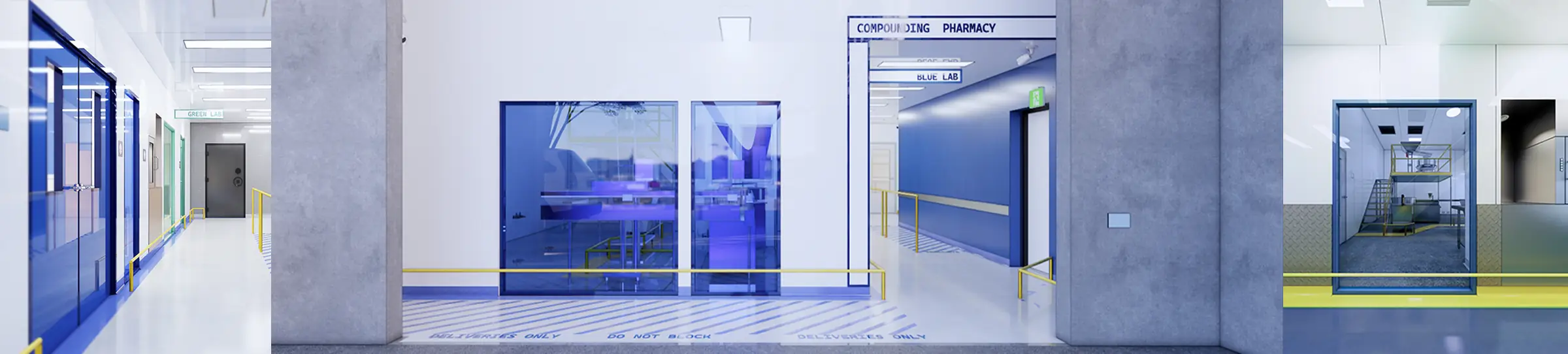
Sterile compounding environments represent the most technically demanding category of pharmacy fitout, requiring a highly specialised and coordinated design approach. At Design Yard 32, we work together with experienced GMP consultants and cleanroom HVAC contractors to plan and deliver sterile compounding pharmacies and pharmaceutical cleanrooms that meet stringent operational and regulatory expectations.

These facilities rely on ISO-classified cleanrooms, rigorous GMP-aligned principles, and precisely controlled airflow, pressure, temperature, and contamination management - extending far beyond standard pharmacy compounding design.

Our experience spans sterile preparation environments including IV admixtures, ophthalmic products, and cytotoxic compounding. If you are considering a sterile facility or future expansion, contact us for an initial discussion or site assessment.
What Is Sterile Compounding?

Sterile compounding is the preparation of medicines that must be completely free from microbial contamination, pyrogens, and particulate matter. These products are introduced directly into the body - by injection, infusion, inhalation, or contact with sterile tissues - where even minor contamination may present serious patient risk. For this reason, sterility is not only a procedural requirement but a critical patient safety obligation.

Australian sterile compounding pharmacies commonly prepare:

  • Intravenous (IV) solutions and admixtures

  • Intramuscular and subcutaneous injectables

  • Intrathecal preparations

  • Ophthalmic drops and irrigations

  • Intraocular preparations

  • Wound irrigations

  • Bladder irrigations

  • Nebuliser solutions

  • Inhalation preparations

Unlike non-sterile cleanroom compounding, sterile compounding requires both advanced aseptic technique and a purpose-built ISO-classified cleanroom environment supported by validated engineering controls.

For non-sterile compounding pharmacy design, see our Compounding Pharmacy Design page.

Regulatory Requirements for Sterile Compounding

Designing a sterile compounding pharmacy requires strict compliance with Australia's regulatory framework. Facilities producing sterile medicines must meet TGA compounding pharmacy requirements, aligned with the Australian Code of GMP (PIC/S PE 010-4 equivalent). At Design Yard 32, we integrate pharmaceutical cleanroom design and GMP cleanroom principles from the planning stage, delivering facilities capable of fully compliant sterile preparation.

Key GMP principles include:

  • Contamination prevention: Segregated zones, HEPA-filtered airflow, and personnel gowning

  • Validated cleaning: Consistent sterilisation of surfaces and equipment

  • Environmental monitoring: Particle counts, microbial testing, temperature and humidity control per ISO 14644-1:2015

  • Documented systems: SOPs, batch records, cleaning logs

  • Equipment and premises qualification: Cleanroom and equipment validation

Australian cleanrooms follow PIC/S PE 010-4 Annex 1, with ISO classifications linked to EU GMP Grades A through D to define high- and low-risk zones. In addition to GMP, facilities must comply with Pharmacy Board of Australia and AHPRA professional standards, state licensing conditions, APF 24th Edition Section 18, and SHPA guidelines for hospital sterile compounding.

Pharmaceutical Cleanroom Equipment

The HVAC system is the heart of a sterile cleanroom, controlling airflow, pressure differentials, temperature, and humidity to maintain compliant environmental conditions. Working closely with verified HVAC contractors, we coordinate service zones early in the design process, allowing sufficient ceiling voids and planning for above-ceiling ductwork and mechanical services from the outset.

At Design Yard 32, all critical equipment - including laminar airflow workstations, biosafety cabinets, and isolators is integrated during the earliest layout stage. Early coordination ensures appropriate airflow performance, electrical supply, exhaust routing, and structural support requirements are addressed before construction begins. Equipment dimensions, weight, and operational requirements are considered from day one, helping avoid costly retrofits and operational disruptions later.

How Good Design Reduces Cleanroom Cost

Sterile compounding facilities represent a significant capital investment. Thorough upfront design reduces overall project cost in several important ways. Well-coordinated layouts minimise the length of HVAC ductwork runs, reducing both materials and labour. Early coordination of equipment footprints, power requirements, and exhaust needs prevents costly modifications during or after construction. Correctly sequenced design documentation supports first-pass building permit approval, avoiding redesign fees and delays. Efficient cleanroom geometry maximises the usable classified area within the available tenancy footprint. And critically, facilities designed with validation in mind from the outset are better placed to achieve IQ/OQ/PQ sign-off without expensive re-runs - a saving that can be substantial.

Controlled Hazardous Compounding

Not all compounding that demands special controls is sterile. Controlled non-sterile hazardous compounding - including oral chemotherapy medications, cytotoxic agents, and potent hormone formulations - requires dedicated containment measures that go well beyond a standard compounding room, yet stop short of a full sterile cleanroom fitout.

A HEPA-filtered containment primary engineering control (C-PEC), combined with a negative-pressure room relative to adjacent spaces, forms the core of a compliant hazardous compounding environment. Closed-system drug transfer devices, dedicated PPE protocols, and clearly defined decontamination and spill-management procedures are equally essential. Facility design must also address hazardous waste segregation and disposal in line with TGA guidelines and state SafeWork requirements - all considerations we build into our designs from the brief stage.

Areas of Expertise

Contact Us

Frequently Asked Questions - Sterile Compounding Pharmacy Design

  • Under TGA GMP guidelines - aligned with EU GMP Annex 1 - and SHPA standards, sterile compounding facilities require a cascade of classified zones, each with specific air cleanliness and monitoring requirements. Grades A, B, C, and D classifications are applied to each room, with Grade A being the cleanest. The exact classification cascade depends on the products being prepared and the risk level of operations. Our role is to design the correct zone sequence and HVAC strategy for your specific scope from the outset.

  • Cleanroom validation is the documented process of proving that your facility consistently meets all required specifications before and during use. It is mandatory for TGA GMP compliance and cannot be skipped, abbreviated, or deferred.

    Validation follows three sequential phases:

    • IQ (Installation Qualification): Confirms all systems, equipment, and infrastructure are installed exactly as specified in the design documentation. Every duct, filter, instrument, and seal is checked and recorded.

    • OQ (Operational Qualification): Confirms all systems operate as intended across their full operating range - including HVAC performance, pressure differentials, air changes per hour, and airflow direction and velocity.

    • PQ (Performance Qualification): Confirms the facility delivers consistent, compliant performance under actual working conditions, including operators present, equipment running, and worst-case production scenarios tested.

    Validation also includes airflow visualisation studies, particle count surveys across all zones, pressure differential mapping, temperature and humidity profiling, and establishing the environmental microbiological monitoring programme that must run continuously once the facility is operational. Annual re-qualification is required to maintain TGA compliance. We coordinate specialist validation consultants as part of our project delivery.

  • It depends - and it is more common than many pharmacists assume. A significant number of Australia's compounding pharmacies have added sterile cleanroom suites to existing buildings through careful assessment and creative design.

    Feasibility factors we assess in any existing building include:

    • Ceiling height to allow routing of HVAC ductwork, HEPA plenum systems, and lighting within the cleanroom ceiling void

    • HVAC routing: Where fresh air intake and exhaust can be positioned, and whether existing mechanical services can be repurposed or must be replaced

    • Electrical supply: Cleanroom HVAC, monitoring systems, and laminar airflow workstations have substantial electrical loads that may require a new switchboard sub-feed

    • Structural capacity: Cleanroom panel systems and heavy HVAC equipment add load; structural assessment confirms whether existing slabs and walls can accommodate it

    • Segregation: Physical separation from non-sterile, retail, and staff areas must be designed into the building flow

    • Gowning sequence: A compliant anteroom and gowning area must fit within the available footprint as a distinct, dedicated zone

  • Both are primary engineering controls used in sterile compounding, but they serve different purposes. A laminar airflow workstation (LAFW) directs HEPA-filtered air across the work surface to protect the product from contamination - suitable for non-hazardous sterile preparations. A biosafety cabinet (BSC Class II) uses recirculated and exhausted HEPA-filtered air to protect both the product and the operator - required when handling cytotoxic or hazardous sterile products. Selecting the correct primary engineering control is a critical early decision in any sterile compounding fitout, and our designs account for equipment type, placement, and exhaust requirements from day one.

  • GMP compliance requires a continuous environmental monitoring programme once the facility is operational. This includes regular particle count surveys, microbial air and surface sampling, personnel monitoring, differential pressure verification across all zone boundaries, and temperature and humidity mapping. All results must be formally documented and reviewed against predetermined action and alert limits. Our cleanroom designs provide dedicated, accessible monitoring locations aligned with your Environmental Monitoring Plan, making these obligations practical to fulfil rather than an afterthought.

What type of project can we help you with?