Pharmacy Fitout Costs
Get realistic budget expectations for your pharmacy fitout - where costs concentrate, where there's flexibility, and what commonly catches people out.
Planning a pharmacy fitout involves a wide range of costs - from the dispensary and retail display through to compounding facilities, security, compliance, and design. What you spend depends on where you are, the size and condition of your tenancy, and the level of specification your project requires.
This page walks through the key cost drivers and typical budget ranges across different elements of a pharmacy project. It is designed to help you approach the process with realistic expectations - not to replace a proper project brief and builder quote.
Approximate Pharmacy Fitout Cost
Here is how a rough cost for pharmacy fitout can be calculated for your project. When you require an early feasibility study for construction you can use pharmacy fitout cost per m² (average of typical cost ranges throughout Australia):
Entry Level: $1,500 - $1,900 per m²
Standard Community Pharmacy: $2,000 - $3,500 per m²
Sterile Environments: $4,000 - $6,000 per m²
Remote Locations: Up to $7,000 per m²
Community pharmacies in Australia typically range from 50m² to 500m². A very common 150m² metropolitan pharmacy fitout generally falls around $300,000–$450,000 in urban areas of Australia, excluding automation and sterile compounding infrastructure. Of course, this average price can be effected by a number of building conditions and design decision.
Detailed Pharmacy Fitout Cost
When your project is progressing with your designer and initial approvals are achieved, it is a good time to fine-tune construction costs by running a reality check with your builder and requesting a more detailed quote based on the actual design.
At this stage, the designer produces Tender Issue Drawings (or Drawings for Pricing). This set includes detailed plans, lighting layouts, cabinetry details, and specifications for materials, finishes, fittings, and fixtures - providing the builder with sufficient information to prepare an accurate construction estimate.
At Design Yard 32, we understand the importance of this documentation and prepare it with care and diligence.
Cheaper building quotes can understandably be tempting. However, they often result from underestimation, which may lead to significantly higher costs during construction than originally expected.
Dispensary Fitout Cost
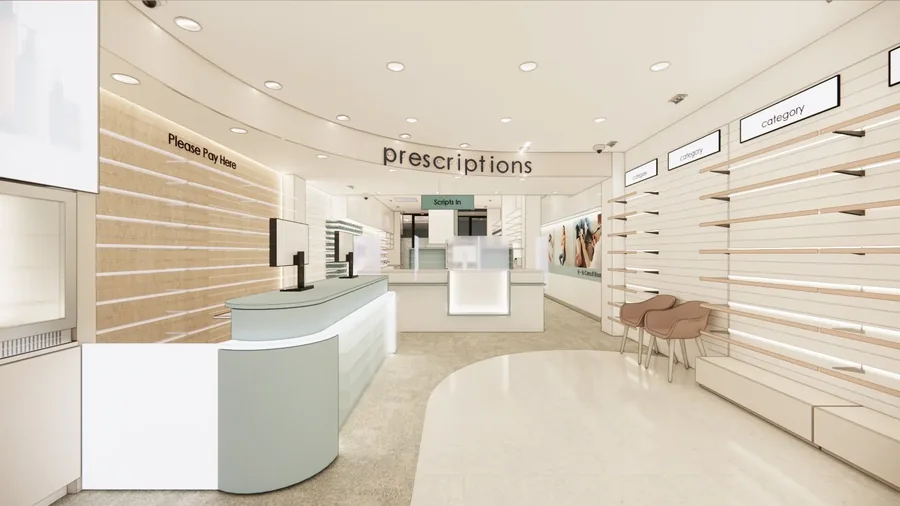
The dispensary is the most specialised and technically dense area of any pharmacy. The cost per square metre is typically 30–60% higher than the retail floor. Even simpler dispensary configurations carry a cost premium, as the density of fittings and service connections remains high regardless of the specification level.
Typical inclusions packed into this relatively compact space include:
Bespoke cabinetry
Specialised shelving and drawer systems
Computer workstations
Robotics and automation infrastructure
Specialised safes and medical refrigerators
Extensive electrical, data, and service connections
Clinical sinks
Pharmacy Retail Fitout Cost
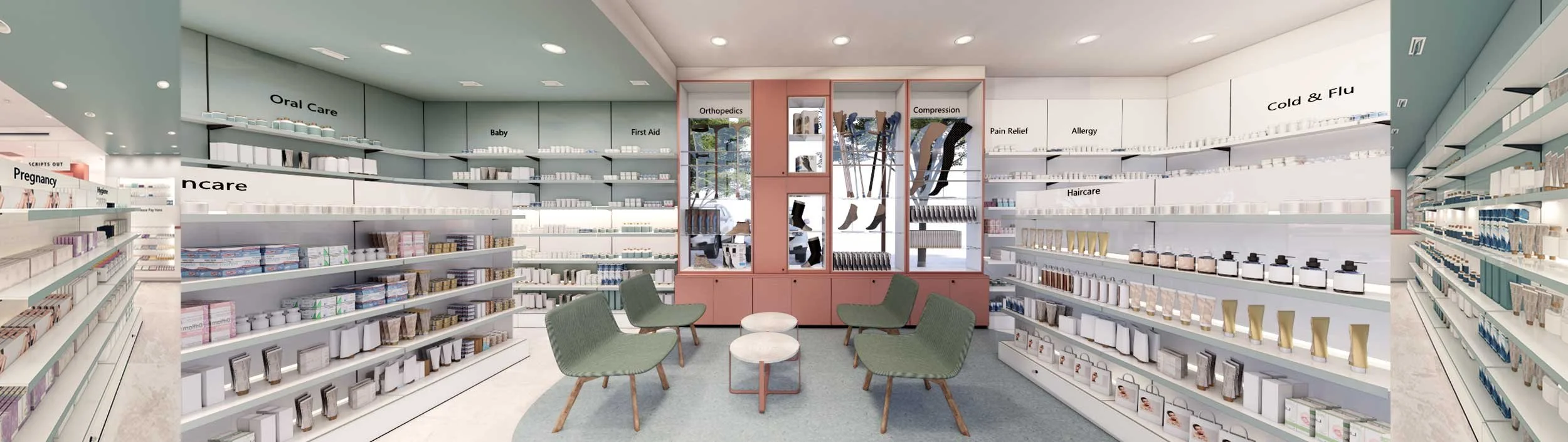
Retail areas offer the greatest flexibility when it comes to budget. The approach to shelving and display largely determines the overall cost. Custom joinery and feature elements typically increase expenditure, while standard metal gondola shelving remains a more cost-effective option and can be dismantled and relocated.
Retail areas generally cost less per square metre than dispensaries because they require minimal plumbing, allow for more economical flooring selections, and involve a lower density of electrical and data services. They also provide greater opportunity to utilise standard or modular shelving systems rather than bespoke cabinetry.
Additional Costs of a Pharmacy Fitout
Security requirements are mandatory in pharmacy environments and contribute to the overall project budget. Additional costs commonly include security alarm and monitoring systems, tenancy perimeter protection, security grilles or shutters, anti-vandal glazing films, and vault installation where required by regulatory or insurance obligations.
Unexpected conditions in existing buildings are another frequent source of cost increases. These may include asbestos removal, termite damage, water ingress or leaks, outdated plumbing, ageing electrical infrastructure, and concealed structural elements that only become apparent during construction.
Project coordination also plays a significant role in cost control. Budget overruns often arise from unaccounted structural elements, over- or under-specified materials, incomplete cabinetry detailing, poorly coordinated consultant drawings, or unnecessary slab penetrations for building services.
Having delivered both straightforward and highly complex projects, we focus on identifying and mitigating these risks early through structured internal design checklists, close collaboration with builders during the pricing stage, and ongoing cost reality checks throughout construction.
How Location Affects Pharmacy Fitout Costs
Location is one of the most significant variables in any pharmacy fitout budget. Labour market conditions, material supply chains, subcontractor competition, and local award rates all influence project costs.
Metropolitan pharmacies are generally well supported by trades and suppliers, demand pressures and infrastructure activity can still affect pricing.
Regional pharmacies typically experience higher costs than metropolitan projects due to reduced trade availability and the logistics of transporting materials and labour.
Remote pharmacies attract a significant cost premium. Limited trade access, travel and accommodation requirements, freight surcharges, reduced contractor competition, and longer construction timelines all contribute. Utility upgrades such as three-phase power or gas connections can add substantial costs where infrastructure is not already available.
For regional and remote pharmacies, site-specific quoting is essential, as early estimates carry a greater margin of variability than metropolitan projects.
Compounding Lab Costs
Compounding remains a core pharmacy service, and the cost of a compounding facility depends heavily on the type of preparations involved.
Non-Sterile Compounding Rooms
For a purpose-built 10–15m² non-sterile, non-hazardous compounding room, mid-range projects typically land around $20,000–$35,000. This price is based on scenario when HVAC air classification, pressure differentials and cleanroom validation are not required, so the costs remain significantly lower than sterile facilities. Specialist equipment - including HEPA-filtered powder containment cabinets, analytical balances, and temperature and humidity monitoring systems - is additional to the construction cost above.
Sterile Compounding Costs
How Much Does a Pharmaceutical Cleanroom Fitout Cost in Australia?
Cleanroom construction differs significantly from standard commercial fitouts. Materials and detailing must prevent microbial growth, eliminate cracks and porous surfaces, and meet strict cleanability and fire-rating requirements. Many conventional finishes are unsuitable.
A compliant HVAC system includes a dedicated air handling unit, ductwork, HEPA or ULPA filtration, and cooling infrastructure. Specialist supply and installation commonly range from $25,000 to $70,000, with higher costs driven by increased air classification and volume requirements.
Additional cost factors include autoclaves, isolators or safety cabinets, water purification, environmental monitoring, pass-through hatches, electrical upgrades, UPS systems, fire suppression, hazardous waste management, and medical gas services.
With experience delivering cleanroom laboratories across Australia, we guide clients through the regulatory and technical complexity of designing compliant sterile facilities.
How to Build a Pharmacy on a Budget
If you are testing a new location or working within tight capital constraints, a staged fitout approach can make a lot of sense. Rather than investing heavily upfront in a site that is still proving itself, we design layouts that function efficiently from day one while leaving room for meaningful upgrades without major reconstruction.
This kind of approach requires careful planning from the outset - not as an afterthought - to ensure what goes in first does not become an obstacle when you are ready to grow.
Pharmacy Design & Approvals Cost
Every pharmacy project requires professional design and documentation. A typical design package includes an initial layout and 3D views, tender documentation for builder pricing, construction documentation for permits or fitout certification, ACPA plans, and Pharmacy Board submission plans. Design fees vary with project size, complexity, and documentation scope, so it’s best to discuss your project to understand what a design engagement involves.
Be cautious of designers who avoid producing detailed pricing documentation, as gaps often lead to additional costs when missing work must be completed mid-project. Similarly, watch for designers who step back during construction, lack pharmacy-specific experience, or focus primarily on selling equipment or shelving.
At Design Yard 32, we guide clients from concept through approvals and construction, staying involved, collaborating closely with builders, and providing additional drawings when required.
Depending on your project, you may also need structural engineering, energy assessments, HVAC design for cleanroom projects, or GMP and TGA consultancy and validation. Planning permits may also be required for shopfront alterations, signage, glazing modifications, or tenancy works. We help clients navigate council consultation and submission processes, identifying permit triggers early to avoid delays.
Areas of Expertise
Contact Us
Frequently Asked Questions - Pharmacy Fitout Costs
-
Pharmacy fitout costs vary widely depending on location, size, services required, and the level of specification. A standard community pharmacy in a major metropolitan area typically falls between $2,000 and $3,500 per m², with remote or heavily serviced projects sitting above this range. A 150m² metropolitan pharmacy will generally cost $300,000–$450,000 to fitout, excluding automation, compounding, or cleanroom elements. We provide project-specific budget guidance once we understand your site and scope.
-
The dispensary is consistently the most cost-intensive area - typically 30–60% more per square metre than the retail floor - due to the density of bespoke cabinetry, specialised storage, safes, refrigeration, computer infrastructure, and services. Sterile compounding suites and dispensing robot installations represent the highest individual cost items in specialist pharmacy fitouts.
-
Yes - a preliminary budget estimate is possible from an early brief. However, rough estimates carry real uncertainty until design documentation is developed and builder pricing is obtained. We provide realistic budget guidance early in the project to support your financial planning, and refine cost estimates as the design develops. Proceeding to construction based on a ballpark figure without documented design and builder quotes carries meaningful financial risk.
-
A non-sterile, non-hazardous compounding room (typically 10–15m²) generally costs $20,000–$35,000 for the fitout construction component, covering walls, ceiling, door, cabinetry, sink, lighting, electrical works, and a general ventilation upgrade.
Specialist equipment — HEPA-filtered powder containment cabinets, analytical balances, and monitoring systems — is additional to the construction cost above. Sterile compounding suites involve substantially higher costs — contact us to discuss your specific scope and requirements.
-
Builder quotes for construction typically do not include design and documentation fees. Professional pharmacy design services - covering layout design, 3D visualisation, tender documentation, construction drawings, pharmacy authority submissions, and ACPA plans - are scoped to suit your project. These fees are a necessary investment that directly reduces the risk of costly errors, approval delays, and construction variations. Contact us to discuss what a design engagement would look like for your project.
-
A cost-effective pharmacy fitout starts with the right design strategy. Standard metal gondola shelving in the retail area and efficient off-the-shelf dispensary systems. The dispensary is typically the most expensive part of a pharmacy, so you can choose to focus on designing for growth - investing only in the most-used operations during your first year, but allocating space for growth in the future. We design budget pharmacy fitouts for clients testing new locations or working under capital constraints - planning for staged upgrades so the pharmacy can grow without major reconstruction. What we do not recommend is compromising on dispensary ergonomics, compliance, or security, as these carry real operational and regulatory risk.