
Cannabis Dispensary Fitout Costs in Australia: Budget Ranges, Drivers & Savings
Designing and building a dispensary inside a community pharmacy is a careful balance of clinical workflow, privacy, and security. In Australia, medicinal cannabis is a prescription service delivered through pharmacies, subject to national and state rules. The Therapeutic Goods Administration explains access pathways and professional responsibilities on its medicinal cannabis hub, and prescription advertising restrictions guide what you can and can’t say on shopfronts and in‑store messaging (TGA – advertising). Premises layouts are shaped by controlled medicines requirements published by state and territory health departments and pharmacy regulators, as well as the National Construction Code and disability access duties.
This guide is written for Australian pharmacy owners planning a stand‑alone tenancy (with brief notes on shopping centres). It focuses on a base‑build scope and generalised, planning‑stage budget bands, not quotes. Throughout, we link to credible public sources so you can review the underlying compliance context. If you are at concept stage and want a practical path from layout to approvals, see our services at Design Yard 32 – Pharmacy Fitout and our coordinated commercial design process.
Who this guide is for and what “dispensary” means in Australia
In Australia, the term “dispensary” refers to the prescription supply and clinical service area inside a pharmacy, not a US‑style retail “dispensary.” That distinction matters for cost planning: your layout must support prescription workflows, consultation privacy, and controlled medicine security rather than retail display. Access to medicinal cannabis is managed via clinical pathways explained by the TGA (TGA medicinal cannabis), so your fitout should be framed as health service infrastructure. The Pharmacy Board of Australia Code of Conduct also provides a practical anchor for patient‑centred design choices.
In this article, “base‑build” means the works inside your tenancy to make it functional and compliant as a pharmacy with a dispensary and consultation room. Landlord works, developer contributions, and major building services upgrades are not included unless specifically noted. Budget bands are indicative, ex GST, and intended to start a conversation with your builder and landlord rather than act as a quote.
The compliance lens that shapes cost
Regulation doesn’t just affect paperwork; it defines zones, materials, and services that influence time and budget. Designing with these settings in mind reduces rework and keeps approval reviews straightforward.
The prescription model and advertising limits
Medicinal cannabis is supplied under prescription in Australia. That clinical model requires private counselling spaces and secure handover points, not product‑forward displays. Advertising rules restrict public promotion of prescription medicines, which affects shopfront language and in‑store content (TGA – advertising). Practically, you’ll use neutral, service‑led signage and wayfinding rather than product claims.
Controlled medicines and premises guidance
Schedule 8 (S8) obligations, state premises rules, and pharmacy authority expectations shape your security package and documentation routines. State health department portals outline storage, record‑keeping, and access control requirements for controlled medicines, for example NSW Health – Pharmaceutical Services, Victoria – medicines and poisons regulation, and Queensland Health – licences and permits. Local pharmacy premises regulators, such as the Victorian Pharmacy Authority, provide inspection expectations relevant to secure storage and dispensary layout.
Construction, access and safety settings
The National Construction Code (NCC) establishes core requirements for fire, egress, services, and building performance, which your certifier will check during approvals. Access and inclusion obligations intersect with tenancy design decisions; for practical guidance, the Australian Human Rights Commission hosts resources on disability rights and inclusive premises (AHRC – Disability Rights). Privacy also matters in clinical spaces, and the Australian Privacy Principles provide a baseline for how you handle and shield personal information in consultation areas.
Space planning: the rooms and functions you budget for
A clear diagram of rooms and flows makes scope tangible for landlords, builders, and authorities. The list below reflects common space types in stand‑alone pharmacies.
Dispensary workroom and secure storage
The dispensary workroom typically includes checking benches, shelving for active stock and repeats, and lockable storage for paperwork and controlled documents. S8 items must be separated from general inventory and held in a compliant safe or vault inside a staff‑only zone (jurisdictional details are published by health departments, e.g. NSW Health – Pharmaceutical Services). Avoid public lines of sight to the safe location and allow adequate bench space for reconciliations. Getting the overall layout right before you price the fitout avoids costly late changes - our cannabis dispensary floor plan guide compares the five main layout archetypes and how each affects sightlines, joinery runs, and approval complexity.
Private consultation room
Patients expect respectful, clear conversations; regulators expect privacy. A consultation room with acoustic treatment, seating for pharmacist and patient, and space for a carer supports both objectives. A small bench helps with device demonstrations, and a wall‑mounted screen supports education. These choices support privacy duties under the Australian Privacy Principles and effective communication expectations in health settings. For a closer look at how acoustic treatment, lighting, and material choices work together across the full dispensary fitout, see our cannabis dispensary interior design guide.
Reception, handover, and public circulation
A discreet check‑in point reduces pressure on the main counter and frames the service appropriately. The handover counter should allow quiet conversation while remaining under staff supervision. Payment points, scanners, and printers need to be positioned so cables are tidy and screens are angled away from public view. Paths of travel, counter reach ranges, and clear widths should reflect NCC access expectations (ABCB – NCC) and inclusion guidance (AHRC).
Back‑of‑house and receiving
A receiving bench near the back entrance, quarantine shelves for incoming stock pending checks, a waste route that avoids public areas, and staff‑only circulation are simple inclusions that reduce mix‑ups and support secure movement of controlled stock. If odour or airborne contaminants are concerns in your tenancy context, plan local extraction and sealed cabinetry as part of your base‑build strategy and review workplace exposure settings (Safe Work Australia – airborne contaminants).
Cost drivers you can control
While some costs are locked in by compliance, many are shaped by early decisions. Understanding the main drivers helps you spend where it counts and avoid late changes.
Shell condition and services capacity
An older shell with limited power, dated HVAC, and no plumbing to the dispensary will need more work than a near‑new tenancy. Early checks of switchboard capacity, distribution boards, slab penetrations, drainage routes, and acoustic weak points provide clarity before you request quotes. Confirm what the landlord will deliver versus what is tenant scope to keep “base‑build only” assumptions accurate.
Security package (S8, CCTV, alarms, access control)
Design a security package around demonstrable risks and inspection expectations, not just device count. This usually includes a compliant S8 safe or vault, CCTV over access routes (not the interior of a safe), monitored alarms, and a duress button. Coverage and device quality affect pricing; cable paths and power also matter if the ceiling is tight or heritage‑constrained. Regulatory context for controlled medicines and premises can be reviewed via state portals such as Victoria’s medicines and poisons regulation and Queensland Health licences and permits.
Joinery, finishes and cleanability
Durable, easy‑clean surfaces reduce maintenance and keep the dispensary looking professional. In practice, that means robust benching at checking stations, laminate or solid‑surface worktops with sealed edges, and cabinetry with wipeable interiors. Avoid overly intricate shapes that increase cost and complicate cleaning.
Power, data, lighting and HVAC
Dispensaries need dense power and data at benches, secure cable management, and task lighting that reduces eye strain. Plan for separate circuits where critical terminals or fridges are used, and specify lighting that avoids glare in CCTV fields of view. HVAC zoning can improve consultation comfort and reduce noise bleed into the retail area.
Fire, egress, and approvals
Older tenancies sometimes need fire detection, exit signage, or door hardware upgrades to meet current standards. A clean, coordinated set of drawings that shows egress paths and device locations reduces backwards‑and‑forwards during approvals under the NCC. Keep a short register of approval conditions and where they are addressed on the plans.
Regional market factors
Labour availability, material lead times, and delivery costs vary across Australia. Regional projects may require longer lead times for certain trades or devices. Simple scheduling buffers and an allowance for limited re‑work protect your timeline without inflating the whole budget.
Budget ranges: planning bands, not quotes
Costs move with scope, condition, and market. The bands below are presented to frame early conversations with landlords, builders, and lenders. They refer to base‑build works for stand‑alone pharmacies.
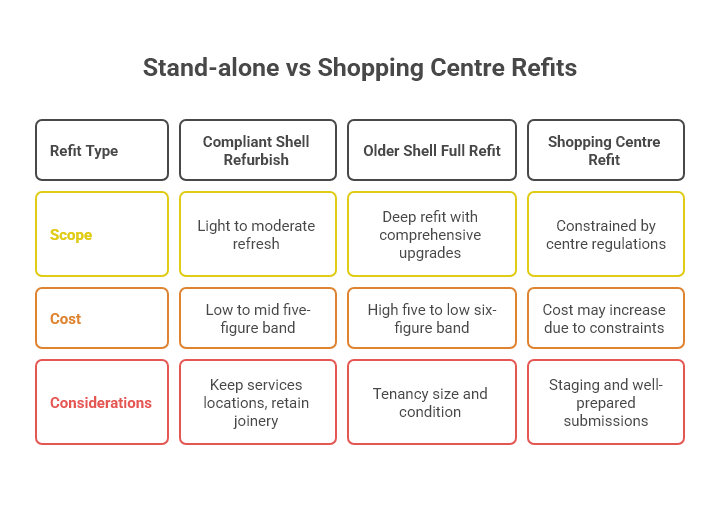
Refurbish a compliant shell (stand‑alone): Often a “light to moderate” refresh sits in the low to mid five‑figure band ex GST when you keep services locations, retain much of the joinery, and focus on a new consultation room, privacy improvements, and a modest security tune‑up.
Full refit of an older shell (stand‑alone): A “deep refit” with service upgrades, new dispensary benches, full security package, new flooring, and coordinated lighting commonly sits somewhere between the high five‑figure and low six‑figure band ex GST, depending on tenancy size and condition.
Brief note on shopping centres: Centre design manuals, after‑hours work windows, and landlord hold points typically nudge both cost and time upward, and can move a project from one band to the next. Even so, thoughtful staging and well‑prepared submissions can soften these effects.
These are not quotes. They are conversation starters so you can pressure‑test assumptions with your chosen builder. If you want a pre‑tender concept plan and scope notes that reflect your tenancy and authority requirements, our pharmacy fitout team can help (Design Yard 32 – Pharmacy Fitout).
Where time and money are often lost (and how to avoid it)
Hidden conditions and scope creep: Switchboard limits, HVAC capacity, slab penetrations for new sinks, and acoustic flanking paths near the consultation room are classic late finds. A simple pre‑design survey reduces provisional sums and variation risk.
Documentation gaps at tender: Quotes vary widely when plans are thin. A services matrix (who supplies what, where), device counts (for security and fire), and a short specification list (“include these items; exclude these items”) narrow the spread and make selection easier.
Late approvals or design rework: Submitting a clean premises package that speaks the regulator’s language—clear zoned plan, secure storage details, consultation room privacy, and staff sightlines—reduces redraws. Review relevant premises guidance for your jurisdiction (for example, Victorian Pharmacy Authority and NSW Health – Pharmaceutical Services).
Practical ways to save without risking compliance
Keep what already works: Reuse compliant services, retain sound joinery carcasses with new fronts and benchtops, and standardise module widths to reduce custom cutting.
Stage the build smartly: Short phases allow you to keep trading while areas are renewed. Plan secure decanting of S8 inventory and temporary counters, and capture lessons learned after each phase to streamline the next.
Focus spend where it matters: Acoustic privacy in the consultation room, reliable security hardware, durable benching at checking stations, and quality lighting at work surfaces deliver ongoing value in daily use.
Timeline, lead times and cash flow
Typical phases: Concept and authority pre‑checks; detailed design and documentation; permit/certifier review; tender and value engineering; construction; commissioning and handover. The smoother the drawings and the clearer the inclusions list, the tighter the timeline.
Lead items: Security hardware, specialist joinery, certain lighting types, and some HVAC components can have longer lead times. Nominate them early so procurement starts on time.
Contingency: A modest contingency protects against latent conditions and minor compliance rectifications that appear during certifier or authority review. Confirm with your builder how contingencies are drawn down and reported.
Procurement and quoting with fewer surprises
Apples‑to‑apples tendering: Issue a finish schedule, device counts (CCTV, alarms, access hardware), and a concise inclusions/exclusions list. Ask for clarifications in writing so you can compare like‑for‑like.
Builder selection and warranties: Choose teams with healthcare or dispensary experience and a clear defects and warranty process. Ask for example handover packs and commissioning checklists to see how they document compliance.
Case‑style scenarios to compare decisions
Scenario A: Modest refurb in a compliant shell. You keep most joinery and services locations, add a new consultation room or refresh an existing one, tune up security, and upgrade lighting. Time impact is small; trading can continue in phases.
Scenario B: Full refit in an older stand‑alone tenancy. You replan the dispensary, add a fully treated consultation room, rewire power/data, upgrade HVAC zoning, and implement a complete security package. The timeline is longer, but staging can still reduce closure periods.
Scenario C: Shopping centre tenancy (brief). Centre design manuals and after‑hours rules introduce extra coordination and cost. Submissions to landlord review panels add time. Early engagement and neat documentation help keep milestones on schedule.
How Design Yard 32 helps you land the budget and approvals
A strong plan bridges the gap between concept and handover. Our team prepares coordinated drawings, concise scope notes, and authority‑ready submissions so builders can price accurately and regulators can review quickly. For stand‑alone pharmacies adding or refreshing a dispensary, we structure the journey so you understand the trade‑offs, the likely budget band, and the path through approvals.
Explore our pharmacy service offering: Design Yard 32 – Pharmacy Fitout.
See how we stage deliverables and coordinate consultants: Commercial services & process.
If you are collecting quotes or planning a tender, we can produce a concept plan and scope checklist that reflects your tenancy, clinical workflow, and regulator expectations. It’s a practical way to reduce variations and protect your timeline.
-
Start by confirming premises expectations for your state or territory and any pharmacy authority submission requirements. For example, the Victorian Pharmacy Authority and NSW Health – Pharmaceutical Services publish requirements you can translate into plan notes. In parallel, check what your certifier will want to see under the NCC so egress, signage, and services are reflected early.
-
You will generally need a compliant S8 safe or vault in a staff‑only area, separation of S8 from general inventory, CCTV over access routes, monitored alarms, and a duress button. State portals outline storage and records expectations, for example Victoria – medicines and poisons regulation and Queensland Health – licences and permits. Avoid placing a safe within any public line of sight to reduce risk.
-
Plan for seated counselling, wheelchair access, and acoustic privacy. A small bench for clinical demonstration and a wall‑mounted screen improve understanding, and finishes should be easy to clean. These choices support duties under the Australian Privacy Principles and reflect inclusion guidance from the Australian Human Rights Commission.
-
Promotion of prescription medicines to the public is restricted. The TGA advertising framework explains what is allowed, so service‑led language and neutral wayfinding are preferred over product‑led messages. Keep any messaging measured and professional to remain compliant.
-
Use planning bands as guideposts while you refine scope and documentation for tender. A modest refresh in a compliant shell may sit in a low to mid five‑figure band ex GST, while a complete refit of an older tenancy with service upgrades may reach the high five‑figure to low six‑figure band ex GST. For a grounded path from layout to approvals and pricing, review the TGA’s framing of prescription services (TGA medicinal cannabis) and prepare a submission‑style plan for your local authority to reduce redraws.
